It was late at night on Oct. 13, 1939, when U-47 ran aground on a sandbar. That would have been bad enough. But it was not just any sandbar. The U-boat was in the middle of the treacherous channel into the heartland of the enemy fleet, the British naval base at Scapa Flow. The base was well protected by its natural geography, an artificial maze created by deliberately sunken ships and the area’s notoriously treacherous currents.
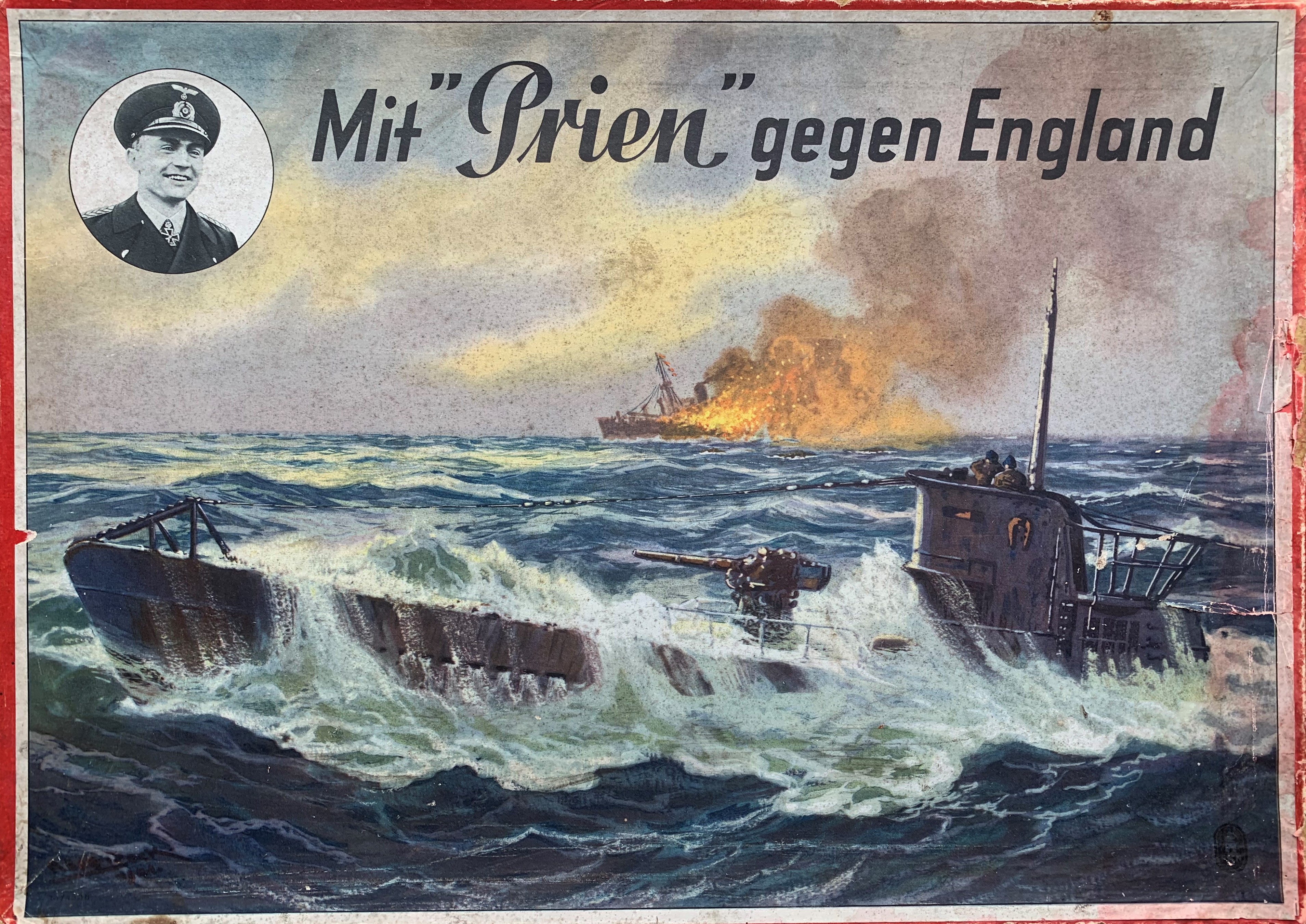
The U-boat’s commander was Gunther Prien. He later was described by William Shirer, an American journalist then reporting from Berlin, as a “clean-cut, cocky, fanatical Nazi”. He refused to give up. He worked his U-boat off the sandbar, narrowly avoided being swept into a dead end, and found himself undetected in the middle of the harbour. He fired three torpedoes at the battleship Royal Oak and what he though was a battlecruiser (actually an ancient seaplane tender).
Only one hit, but despite the explosion, there was no general alarm. So Prien reloaded and fired another spread, which quickly sent the Royal Oak to the bottom.
U-47 returned to its base in Wilhelmshaven on the morning of Oct. 17 with a rampaging bull painted on its conning tower. The crew was met by Admirals Karl Donitz and Erich Raeder, who promptly awarded medals to the entire crew. That afternoon they were flown in Hitler’s personal airplane to Berlin for a parade through the capital, press conferences, speeches and lunch with the Fuhrer himself.
In military terms, the loss of an outdated battleship mattered little. As a symbolic feat it was huge, erasing in an instant the shame of Germany’s failure to contest the seas successfully during WWI. It was a propaganda coup for the Nazi government.
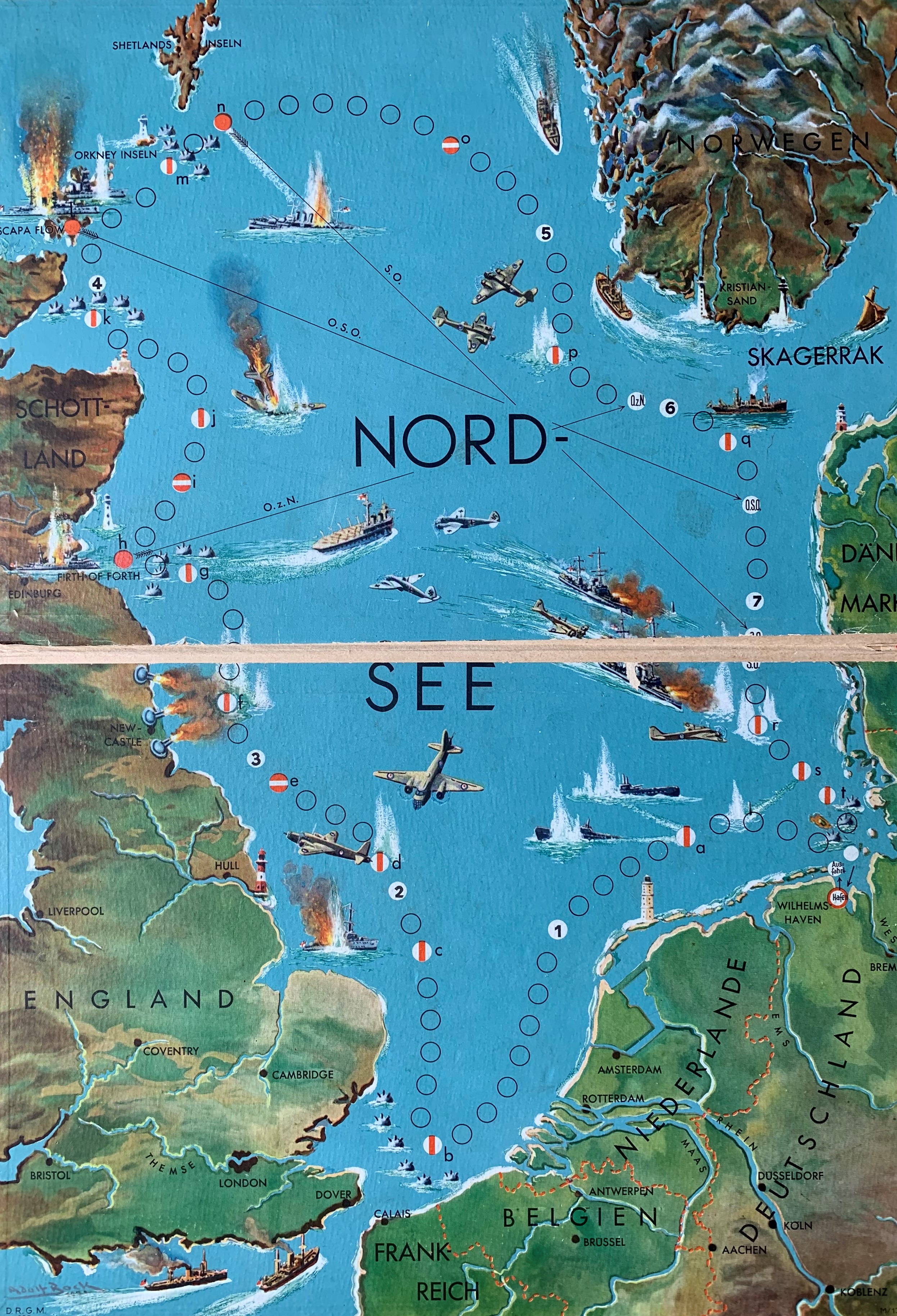
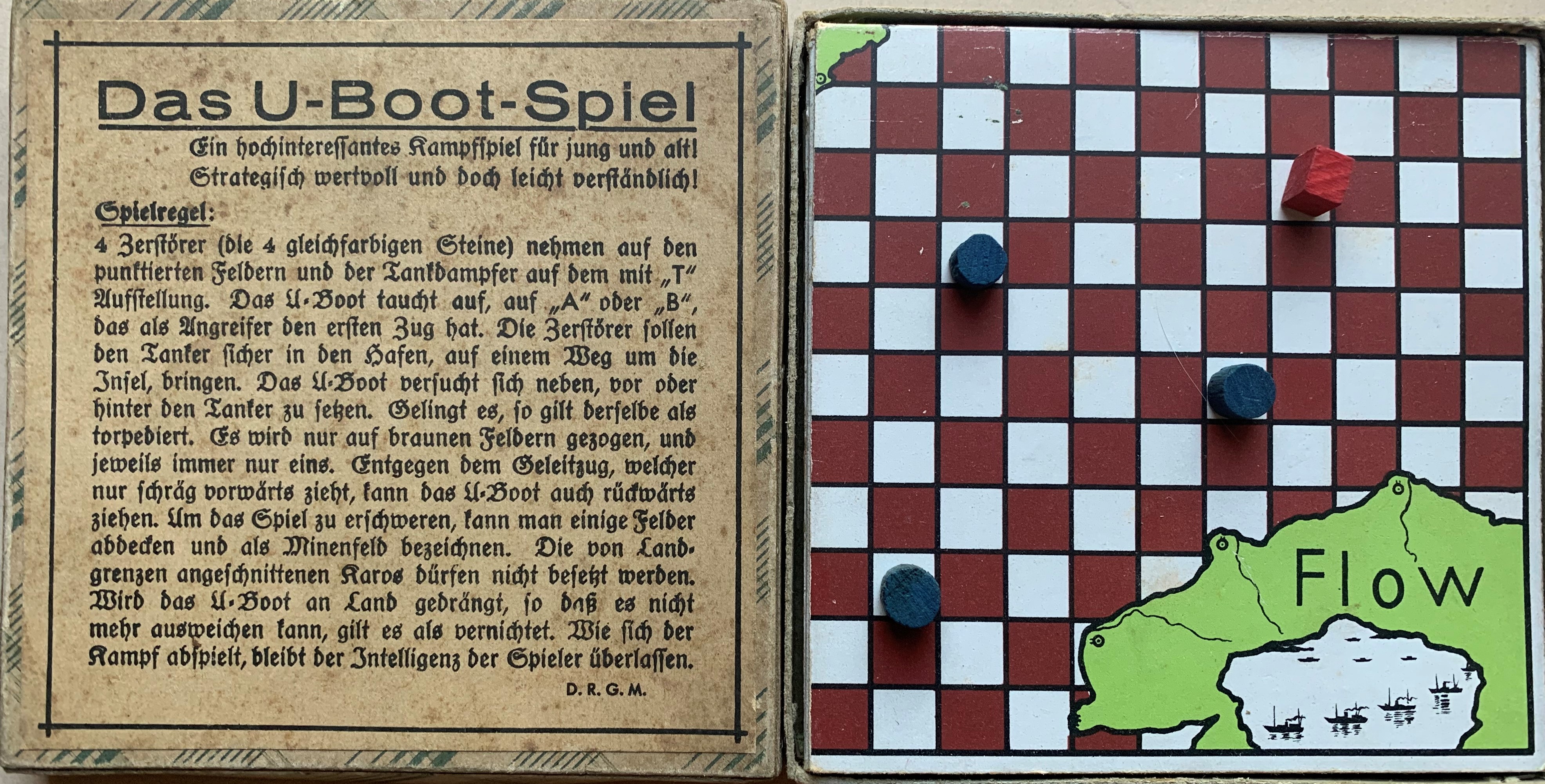
It also provided a profitable opportunity for game makers. The best known game featured Prien’s portrait on the box, and was titled Mit “Prien” gegen England. The Scapa Flow raid was also the subject of a more sober game of maneuver, Das U-boot-Spiel. This involved moving plain blue and red blocks on a 11 x 11 checkerboard grid partly blocked by the irregular landscape around the British base.
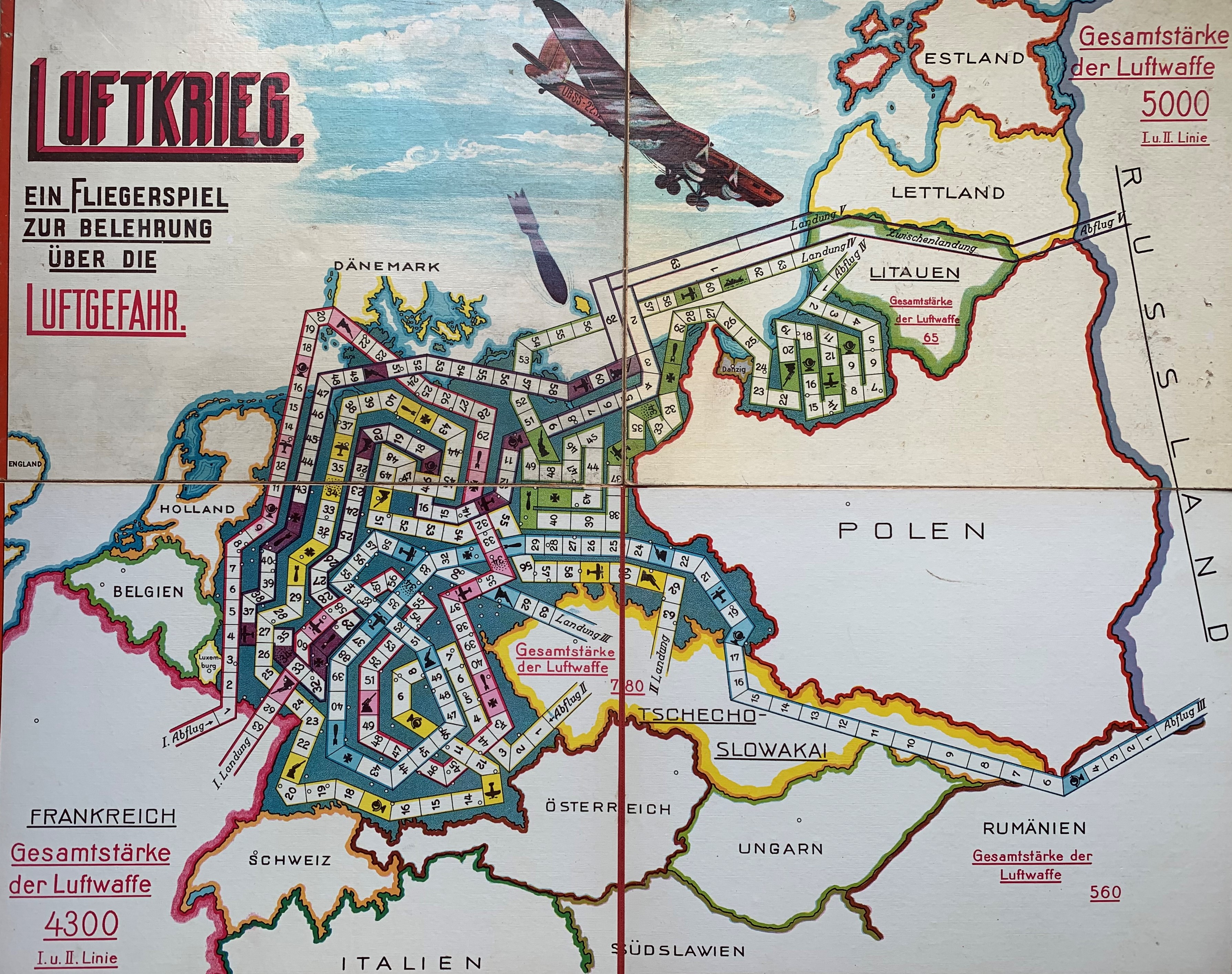
Governments sometimes want to stimulate fear and generate a sense of urgency rather than celebrating victories. Game publishers found ways to feed into those emotions too. The 1930s German game Luftkrieg did not proclaim Germany’s superiority. Rather, with its subtitle Ein Fliegerspiel zur belehrung uber die Luftgefahr (A game about the aerial danger), it bemoans Germany’s aerial weakness and urgent need to re-arm.
In Luftkrieg, players take the role of neighboring powers and fly missions to bomb Germany. The board highlights the huge numbers of warplanes possessed by its neighbors, including 5,000 by Russia, 4,300 by France, 780 by Czechoslovakia, 560 by Romania and even the 65-strong air force of Lithuania. The main illustration on the board shows a Russian bomber loosing a bomb headed toward Berlin.
A game with a similar theme bore the title Deutscher Schutz dich Selbst (German Protect Yourself).
The board shows hordes of black airplane symbols surrounding Germany. This time players represent attacking air forces from England, France, Czechoslovakia and the Soviet Union. They follow inward spiral tracks leading to the heart of Germany. The winner is the first to land on the central space, labelled “Deutschland is schutzlos” (Germany is defenseless)
The game captures both the fear and public anger that brought the Nazi party to power in 1933.
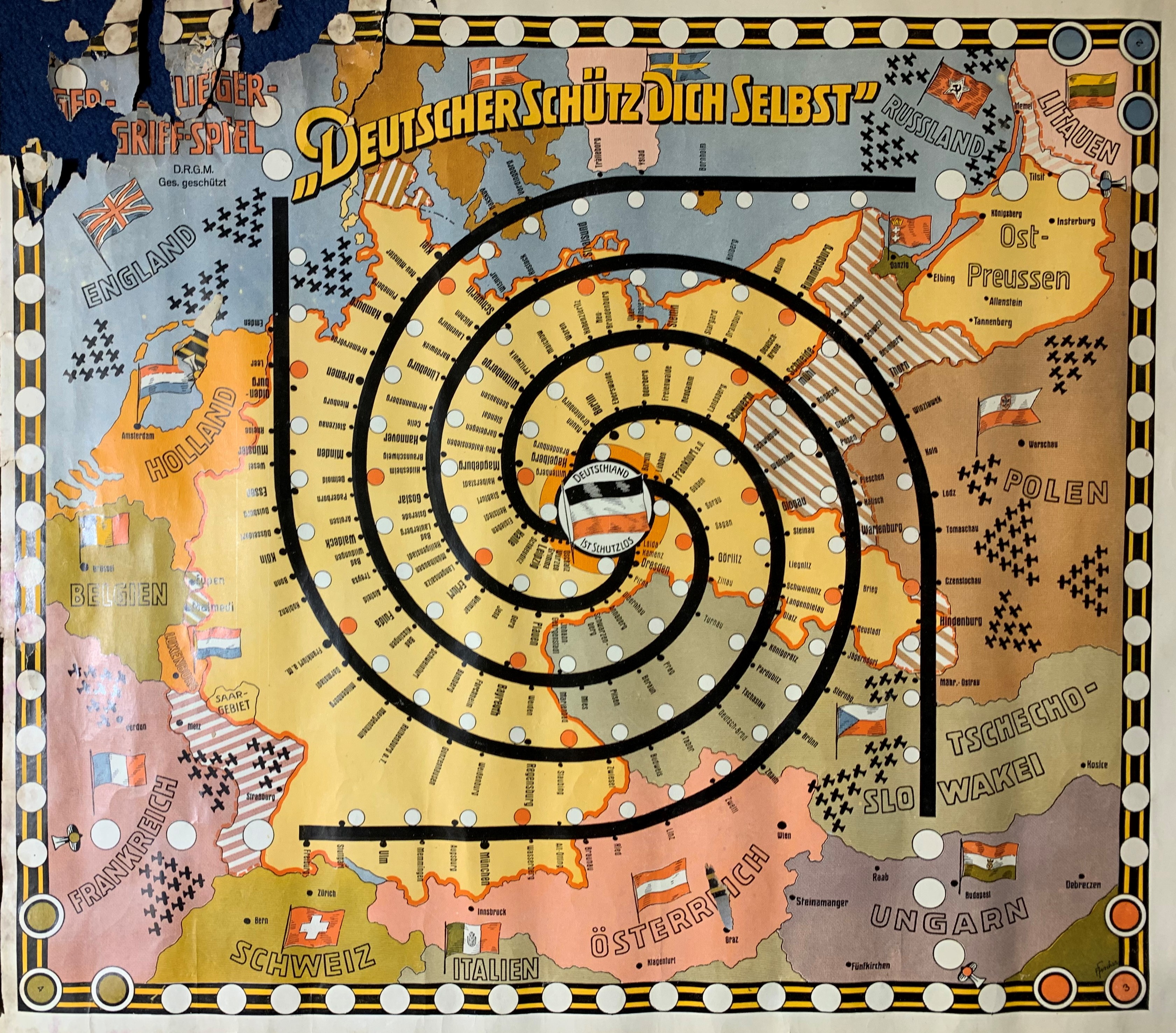
In addition to supporting the idea of re-armament, the game shows as striped areas the territories that were stripped from Germany by the 1918 Treaty of Versailles.
The game’s central space uses the new national flag brought in by the Nazis to replace the black, yellow and red standard of the Weimar republic. This black, white and red flag was in turn replaced by the Nazi party hakenkreuz (swastika) flag as the sole national emblem in 1935. The game therefore reflects public attitudes during the crucial period that led to the 1936 decision to remilitarize the Rhineland in defiance of the Versailles treaty.
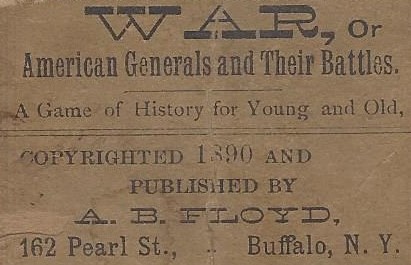
Games that celebrate weakness are rare. Celebrating military success, on the other hand, has a long history in gaming. Back in 1890, A.B. Floyd of Buffalo, New York, produced the card game War: American Generals and their Battles.
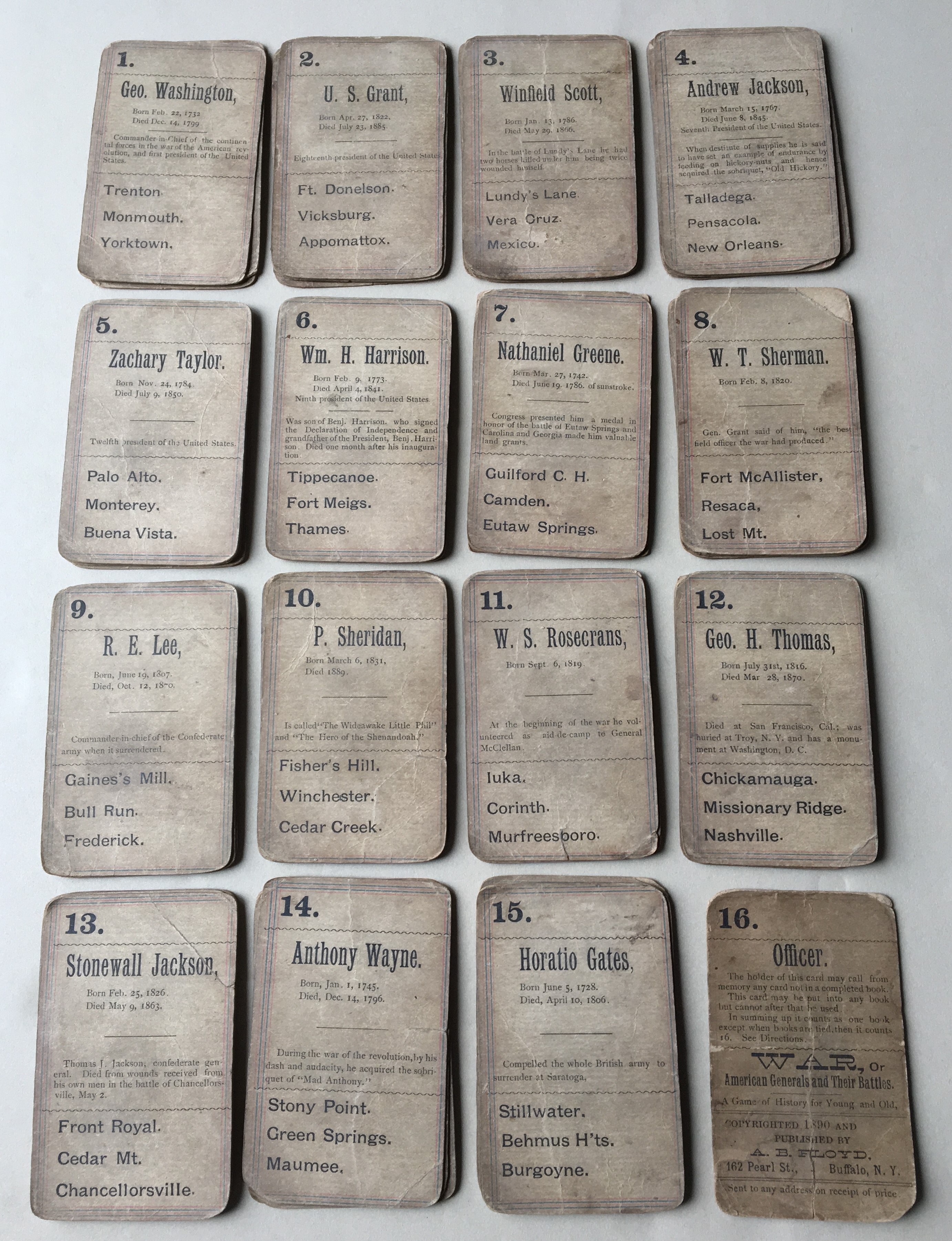
This is a set-collection game similar to Happy Families or Authors. The 61 cards are divided into 15 sets of four, plus a wild card. Each set consists of an American General and three of his battles. The general card has a short biography and each battle card includes a brief description.
Set 1, for instance, consists of George Washington, Trenton, Monmouth and Yorktown. The Yorktown card declares: “The siege which ended in the capture of Cornwallis, Sept. 19, 1781, virtually ended the War of the Revolution”. It goes on to note a second siege of Yorktown during the Civil War, from Apr. 5 – May 3, 1862.
The other generals in the deck are: U.S. Grant, Winfield Scott, Andrew Jackson, Zachary Taylor, William H. Harrison, Nathaniel Green, W.T. Sherman, R.E. Lee, P. Shreridan, W.S. Rosecrans, George H. Thomas, Stonewall Jackson, Anthony Wayne, and Horatio Gates.
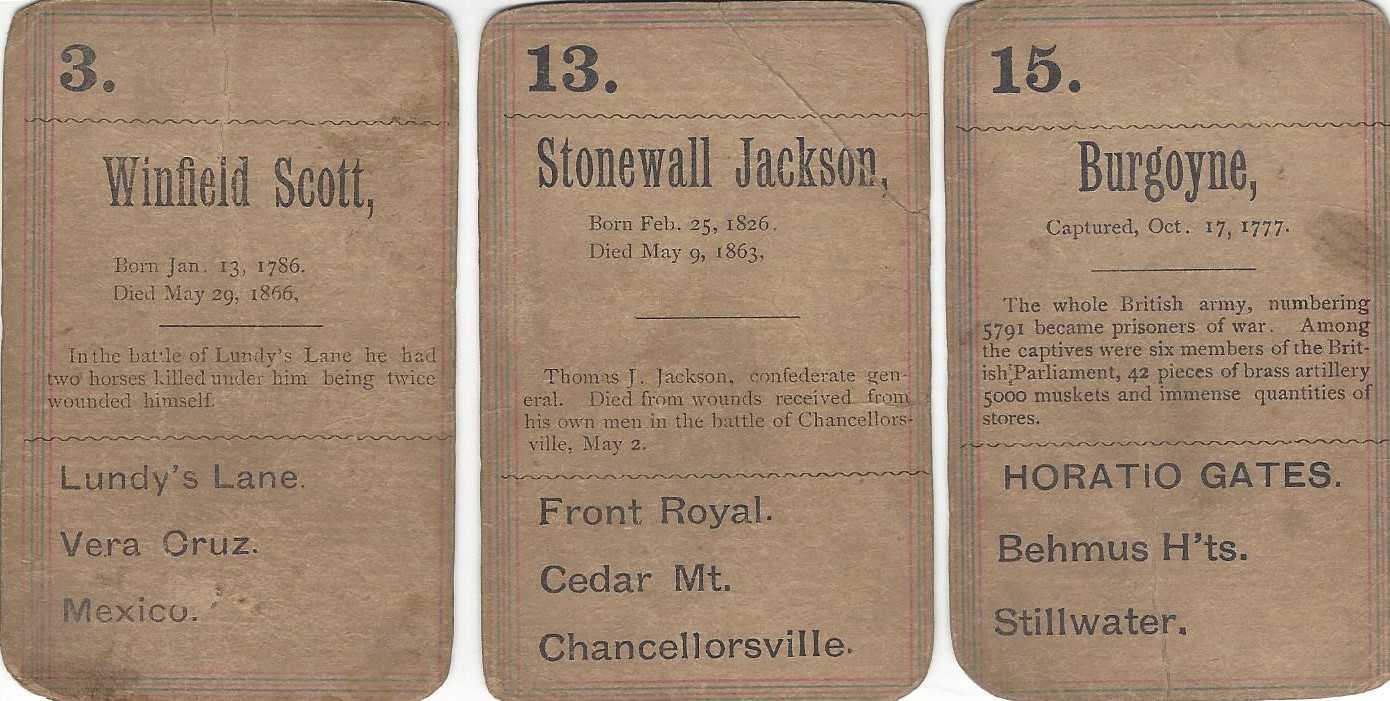
The cards note that five generals went on to become Presidents, that Winfield Scott had two horses killed under him at Lundy’s Lane and that Andrew Jackson got the nickname “Old Hickory” after setting an example of endurance when supplies were short by feeding himself on hickory nuts.
Also noted is that William Harrison died just one month after his inauguration as President, that Stonewall Jackson died of “friendly fire” during the battle of Chickamauga, and that Anthony Wayne acquired the nickname “Mad Anthony” because of his “dash and audacity” during the Revolutionary War.
Set 15, Horatio Gates, has only two battle cards plus a card for the capture of British general John Burgoyne on Oct. 17, 1777. “The whole British army, numbering 5,791 became prisoners of war,” the card reads. “Among the captives were six members of the British Parliament, 42 pieces of brass artillery, 5,000 muskets and immense quantities of stores.”
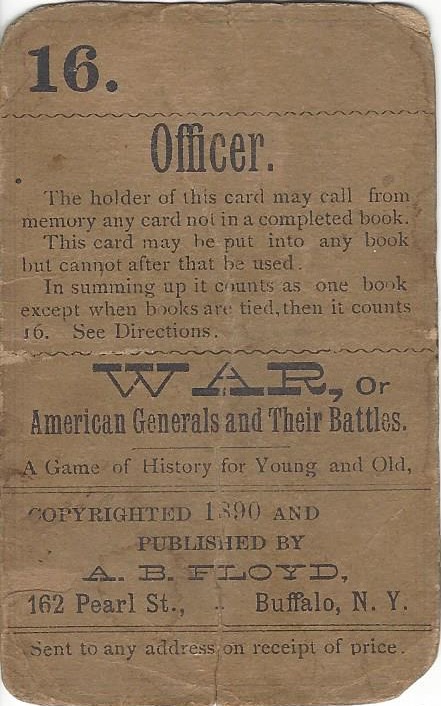
The 61st card is named simply “Officer”. It acts as a wild card, allowing a player to call any card from memory to fill a book. It also acts as a tie-breaker, counting as a single book unless the number of books is tied, in which case it counts for 16. The card also acts as the cover card for the deck. Its bottom half shows the game title, copyright and publisher information.
Sometimes, of course, game makers echoed political predictions of quick and easy victory. At the time Germany launched Europe into four years of extraordinary bloodshed, people on all sides assumed that decisive victory lay only months away. Games such as Der Volkerkrieg aimed to reinforce that optimism. “The People’s War” also reflected the initial popular support for an all-out but presumably short effort.
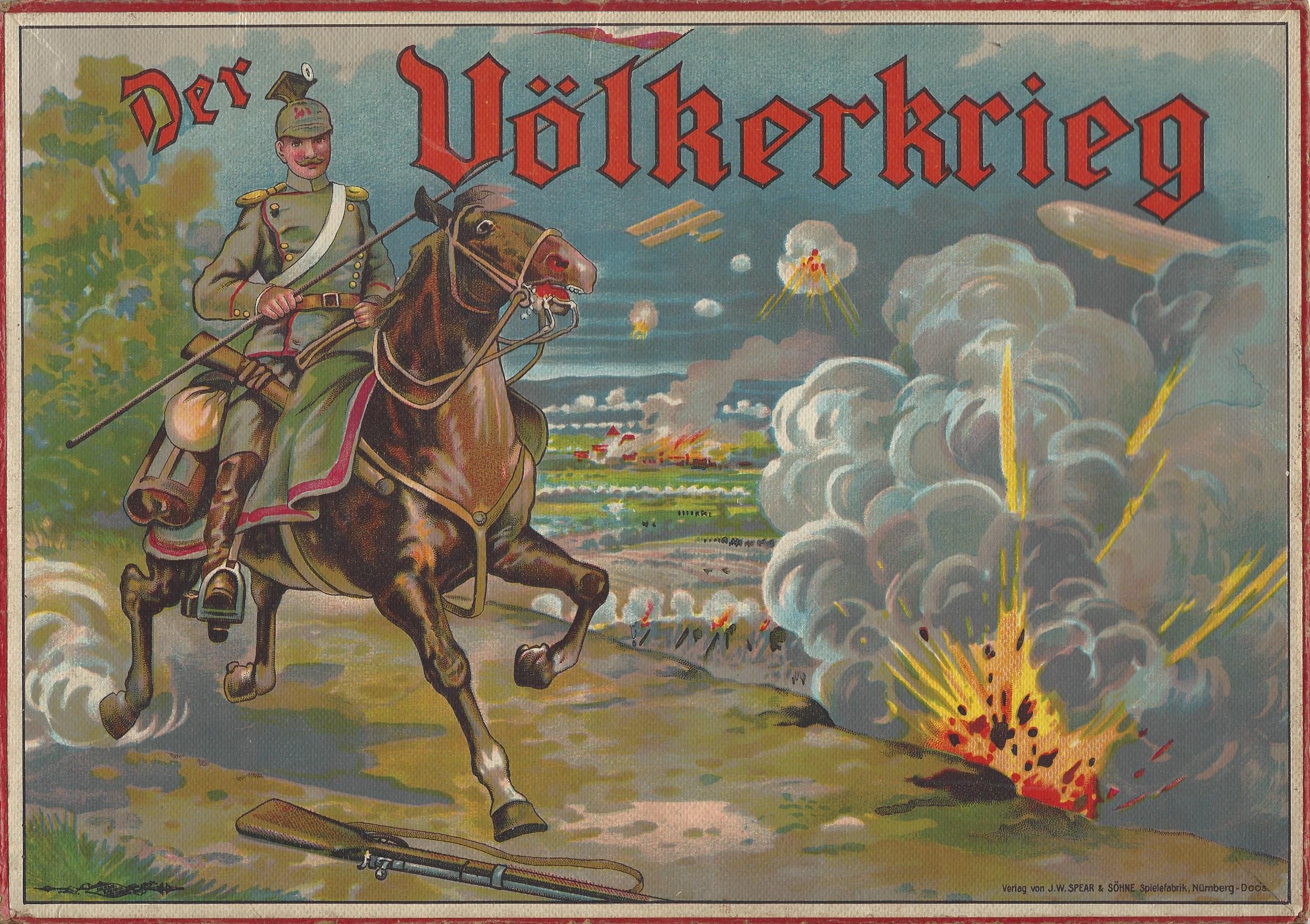
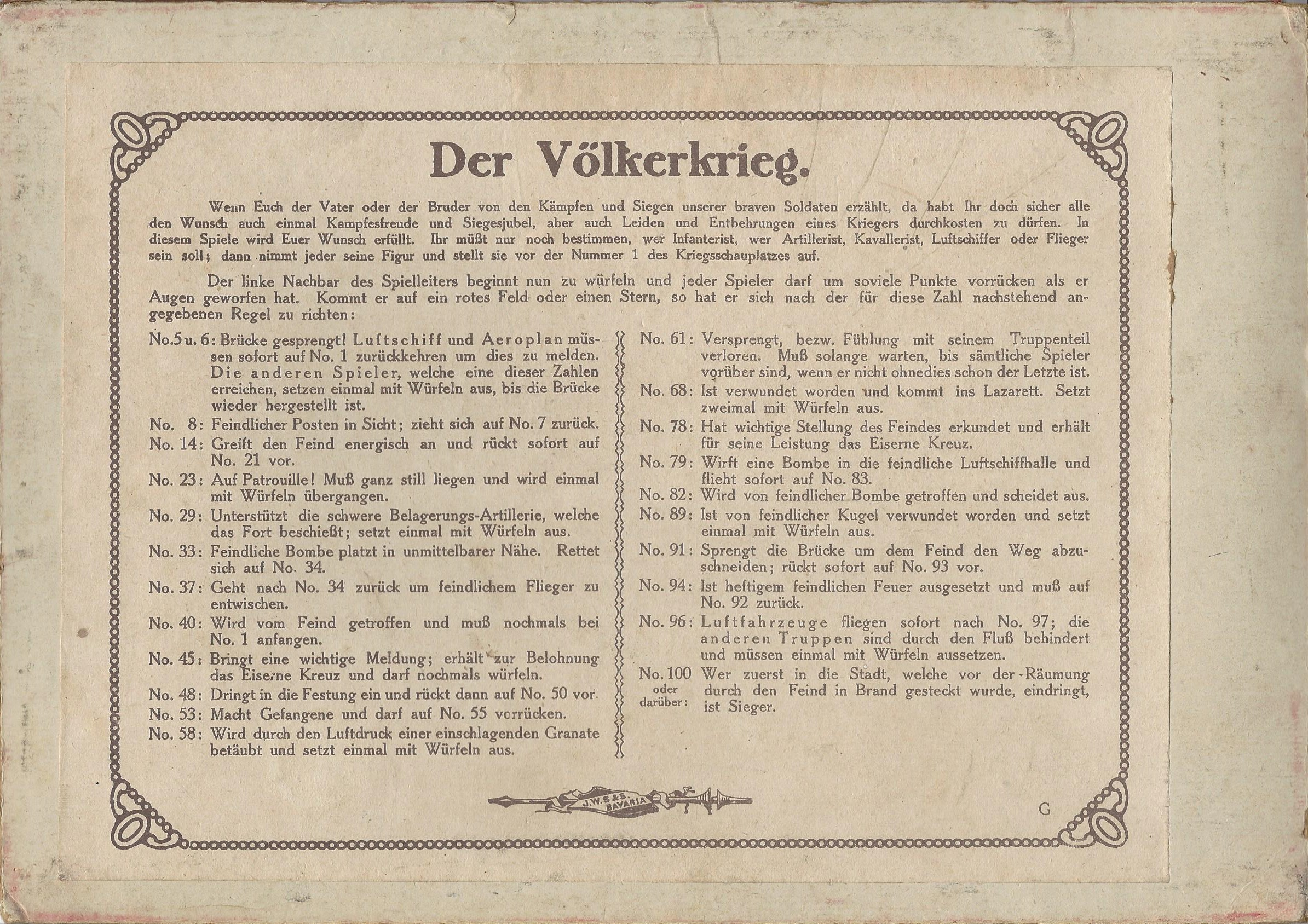
“If you or your father or your brother talk about the fighting and victories of our brave soldiers, then surely you all have the desire to enjoy both the battle and victory, while also experiencing the suffering of a warrior,” the rules begin. “In this game your wish will be fulfilled. All you have to do is determine who should be an infantryman, cavalryman, airman or aviator.”
The games that were most effective in boosting civilian spirits, of course, came from victories achieved rather than imagined. The German game Adler Luftwaffenspiel, for instance, was issued in a new “Europa” edition in 1941. (It was originally published before the war as Adler Luftverdigungsspiel.)
The box was now emblazoned with 13 flags, including those of Germany, Italy, Romania, Hungary, Finland, Slovakia, Netherlands, Spain, France, Belgium, Norway, Denmark and Bulgaria.
Together, they represented the countries either allied with or conquered by Germany by that time. Austria, Poland and western Czechoslovakia are not represented because they were absorbed into Grossdeutschland (greater Germany).
Spain was neither conquered nor a formal ally, but it had friendly relations with Nazi Germany and Fascist Italy because of their intervention on General Francisco Franco’s side during the Spanish Civil War.
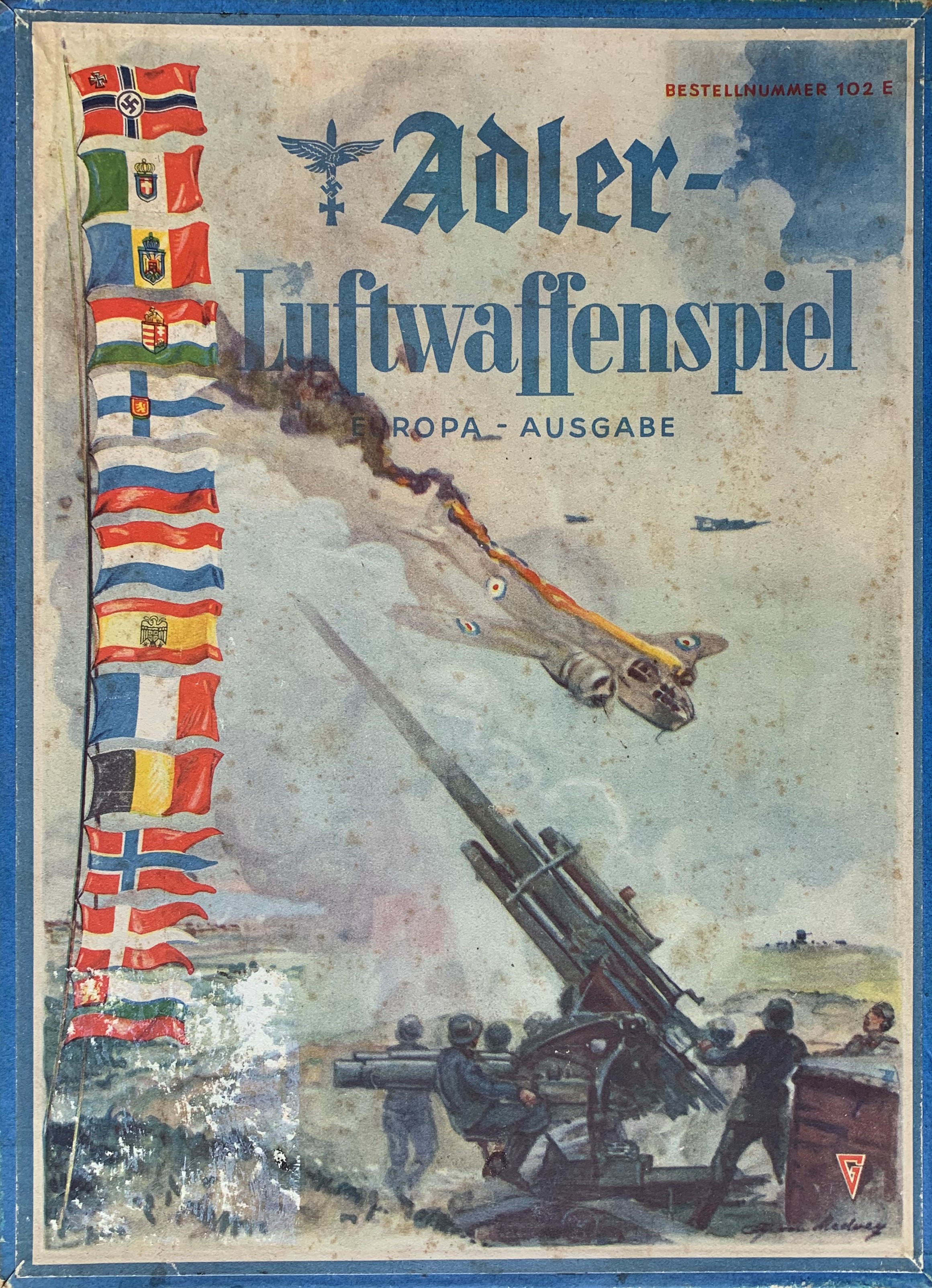
Altogether the game box signaled Germany’s domination of most of Europe. The conquest of the Balkans and Greece and the invasion of Russia were soon to follow.
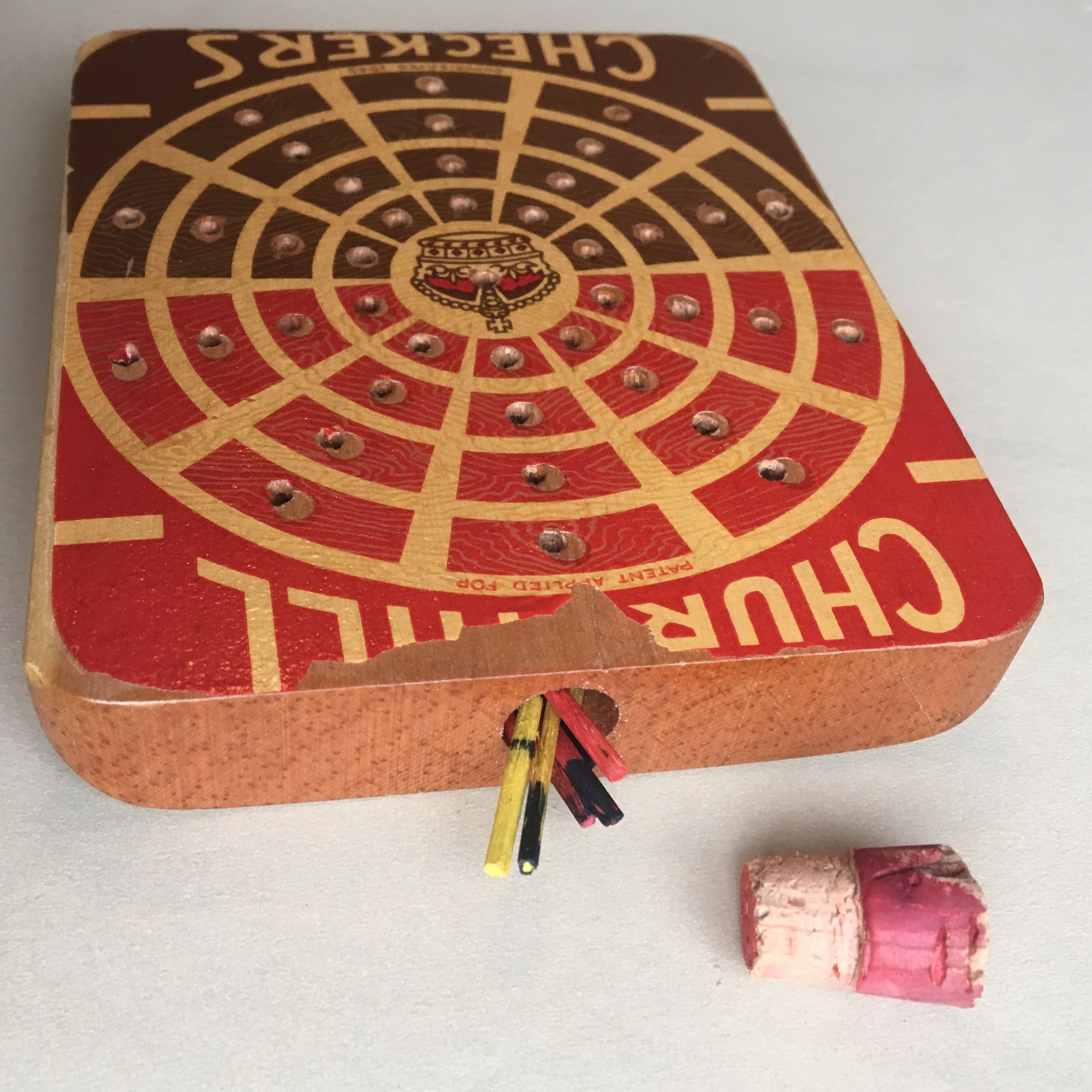
The Allies had little to crow about during the early years of World War II. They had to make do with glorifying their leaders. Winston Churchill stepped into the heroic role naturally, with his defiant speeches about fighting to the end. In Canada, one result was the game Churchill Checkers.
The game is a kind of circular checkerboard printed on a wooden block. It is played with small wooden pegs with one end colored either red or blue. Players start on opposite sides of the circle and move pieces as in checkers. However, they may jump opposing pieces either inward or sideways. Any piece that reaches the crown space in the middle of the circle becomes “kinged” and can then jump outwards as well. The pieces were stored in a hole bored into the side of the wooden block and stopped up with a small cork.
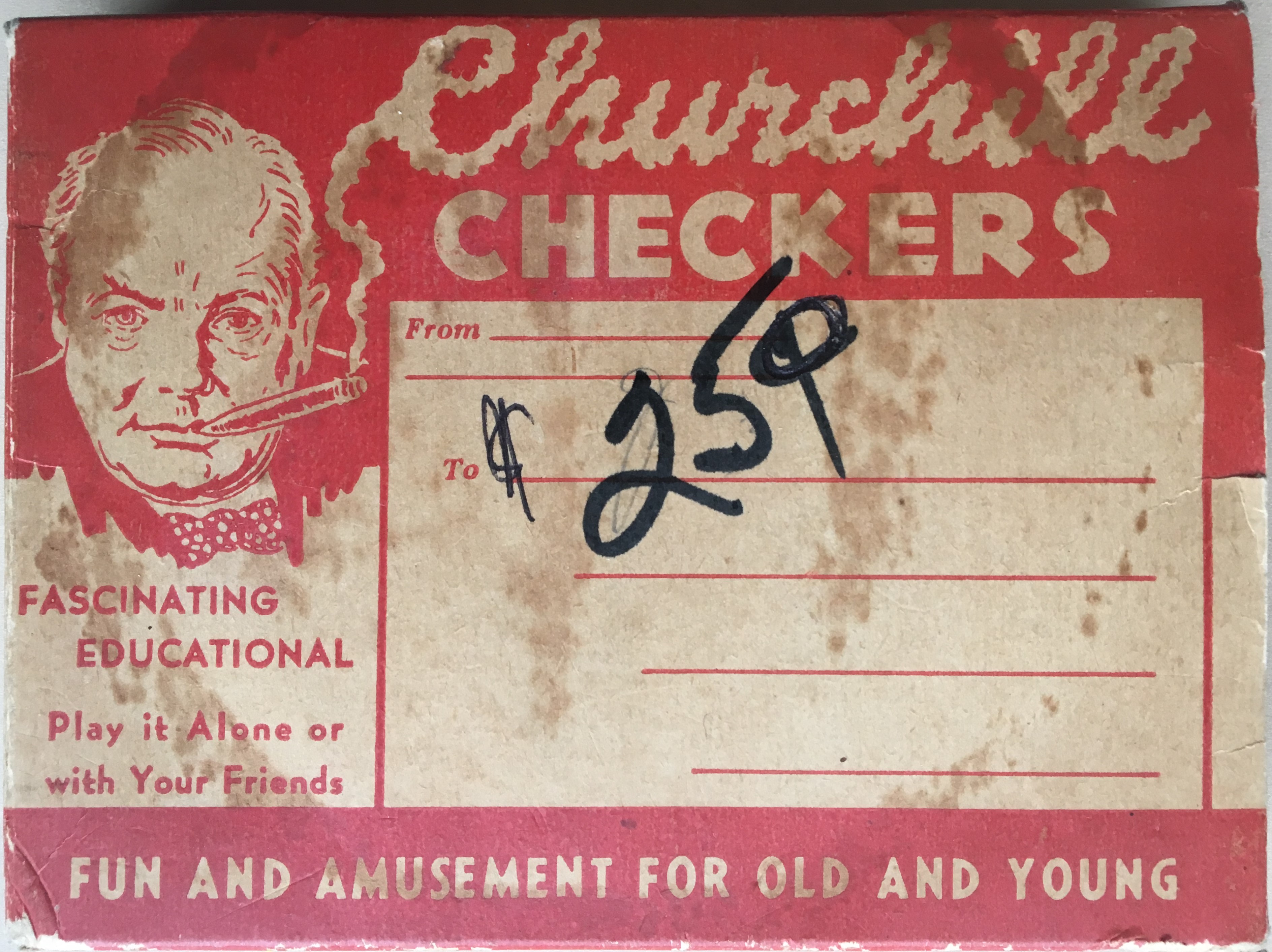
Good slogans from great leaders have inspired soldiers and civilians alike for centuries. The 1942 American game Victo takes the bingo card and turns it into a tablet of inspirational American words.
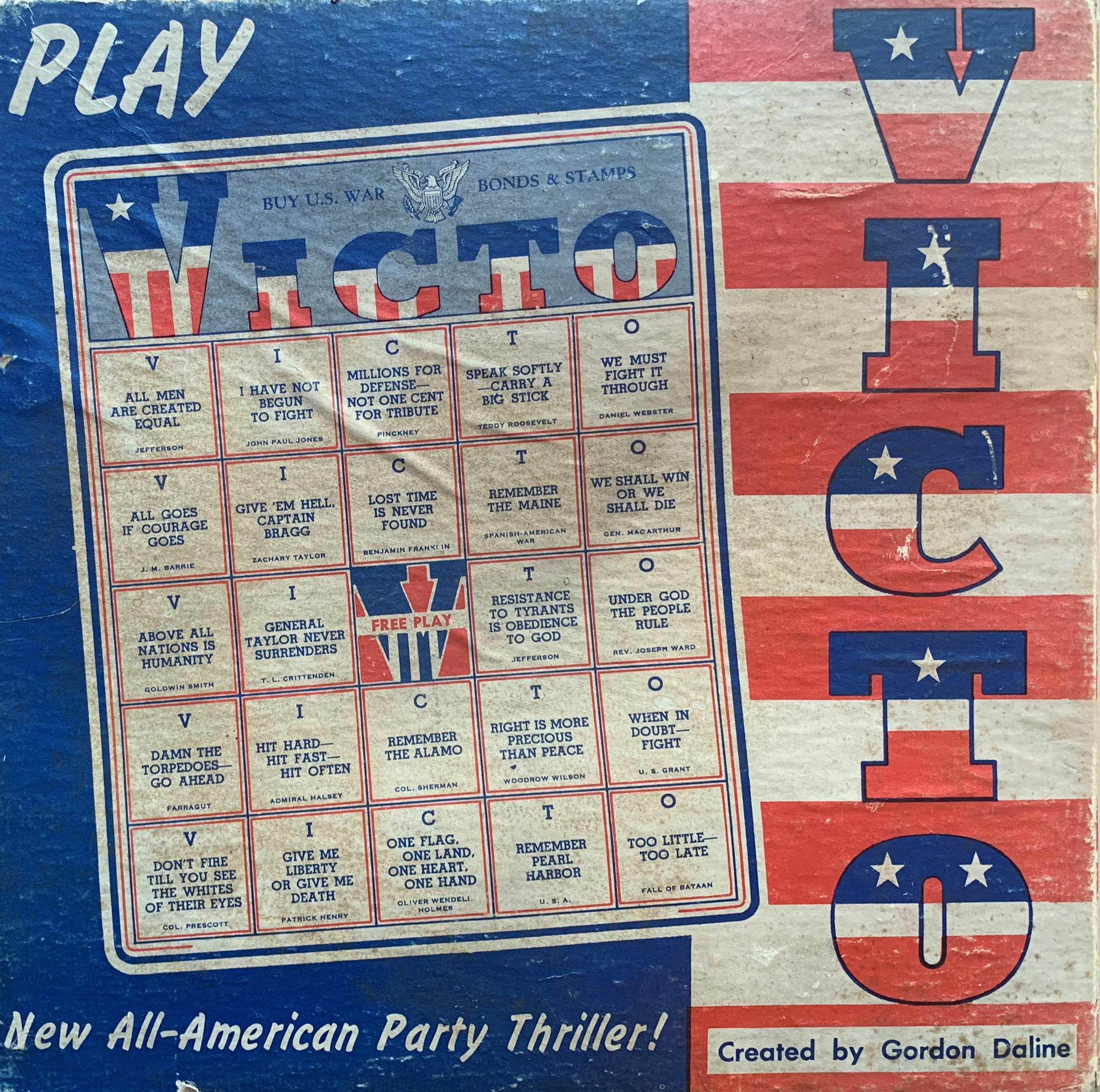
There are 75 tiles, each with a famous quote. These are pulled at random, and players mark off the appropriate spot on their cards if and where it appears. Great quotes from the past predominate: from Patrick Henry’s “Give me liberty or give me death” and Admiral Dewey’s “You may fire when ready, Gridley” to Teddy Roosevelt’s “Speak softly – carry a big stick” and Woodrow Wilson’s “America cannot be an ostrich.”
By 1942, WWII had provided new inspirational words – even if they weren’t actually said by those given credit. There is the apocryphal message from the doomed Marines defending Wake Island in the opening days of the war: “Send us more Japs”. General Douglas MacArthur is credited (dubiously) with the old adage: “There are no atheists in foxholes.”
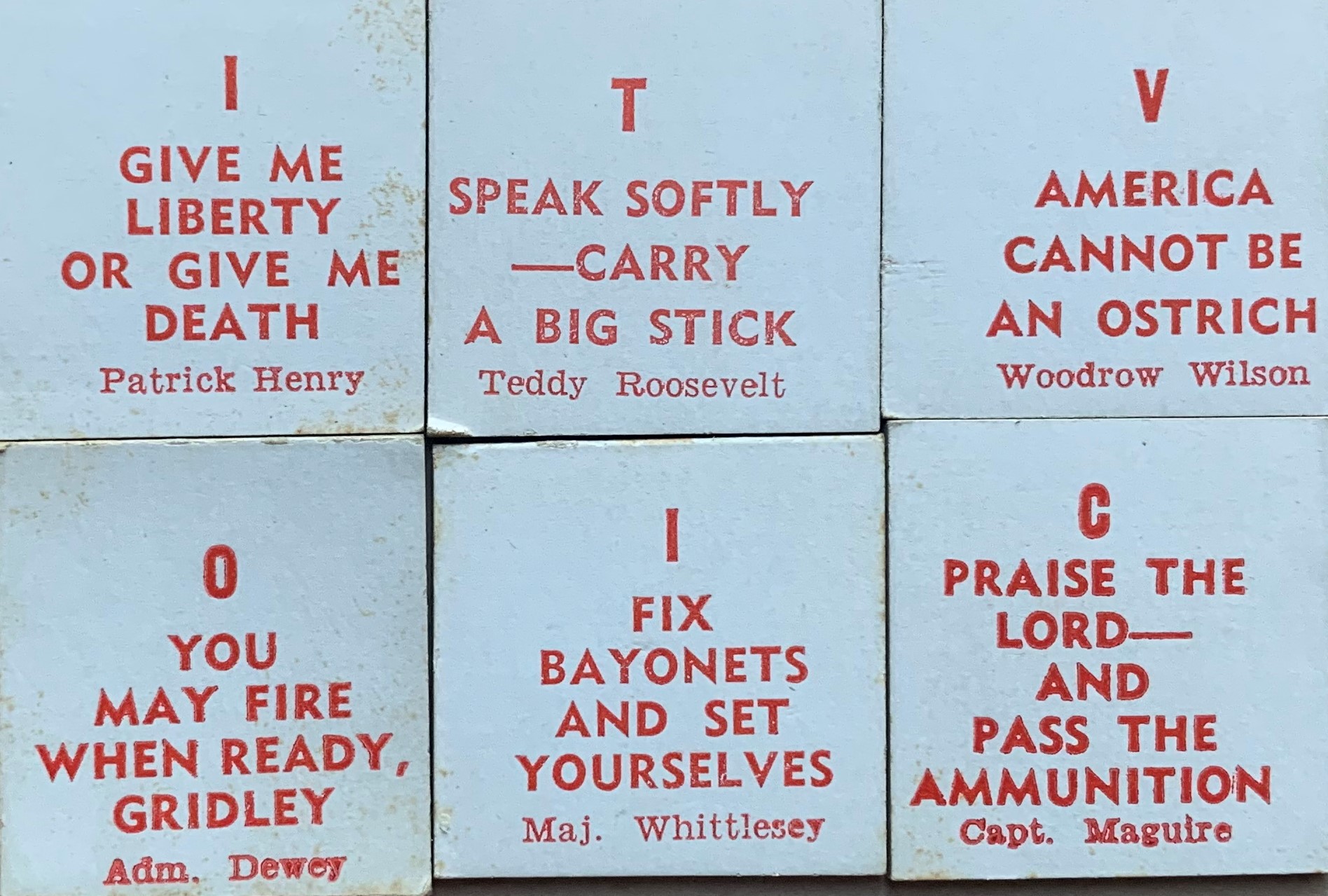
“Remember Pearl Harbor” was clearly adapted from the Spanish-American War slogan “Remember the Maine”. The game also includes words from blunt-spoken Admiral “Bull” Halsey, “Hit hard – hit fast – hit often,” as well as the pragmatic call from the newly appointed head of the War Production Board, Donald Nelson: “Production lines are battle lines.” And the game would not be complete without some bon mots from Franklin Roosevelt, including of course: “The only thing to fear is fear itself.”
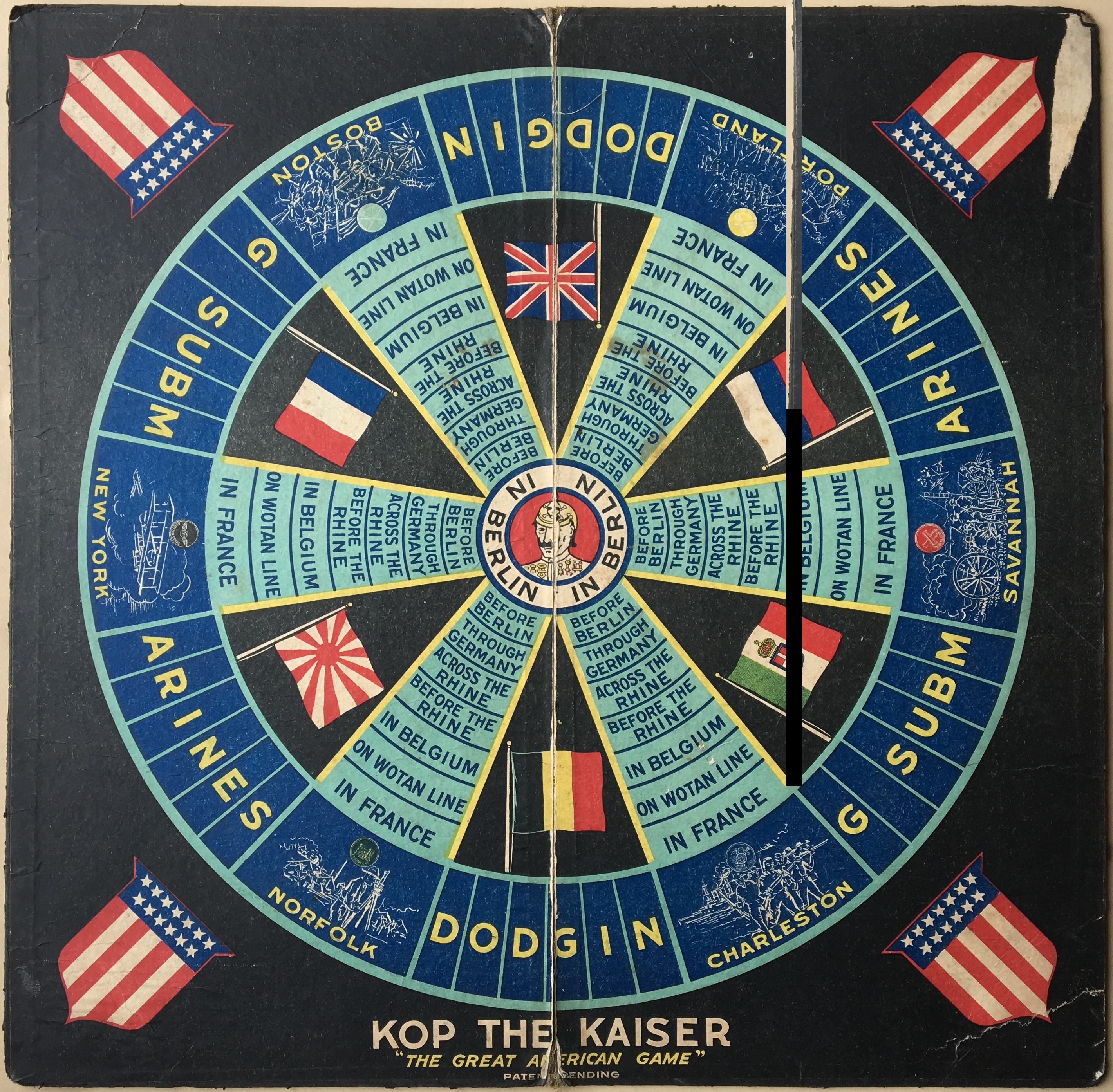
Wartime publishers learned long ago that while celebrating homegrown heroes and triumphs sold games, vilifying opponents was even better. Soon after the entry of the United States into World War I, one American entrepreneur came up with Kop the Kaiser. Each of up to six players represents one branch of the American armed forces: Infantry, Cavalry, Artillery, Marine Corps, Engineers, or the Aviation Corps.
They start from a space representing the headquarters of their chosen branch (Boston, Portland, Savannah, Charleston, Norfolk or New York).
They must roll their way all around the outer circle, “dodging submarines”.
Once back at base, they can head overseas, to France and to combat on the Wotan Line (the northern part of the Hindenburg Line).
Finally, they proceed through Belgium, cross the Rhine into Germany and aim to be the first to enter Berlin and capture Kaiser Wilhelm.
The same idea cropped up during WWII in the Canadian game Nail Hitler. It comes in a brightly colored envelope, but what is inside is just a page of rules and a large paper mat. The center of the mat is a large caricature of Adolf Hitler’s head. It is surrounded by areas marked with particular cards: the 10, Jack, Queen, King, Ace and King and Queen of Hearts. There also are spaces labelled No Man’s Land and The Chamberlain Umbrella.
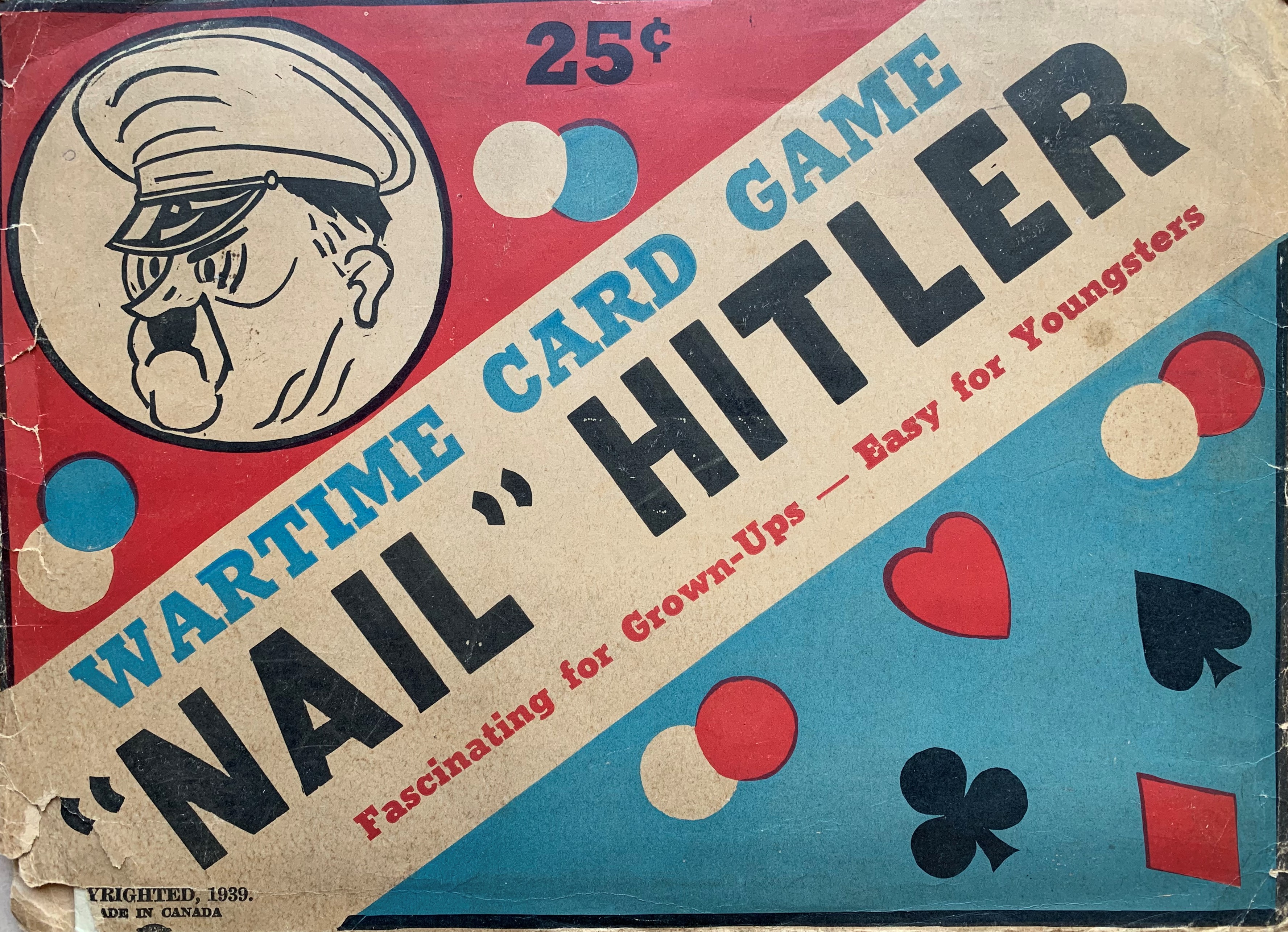
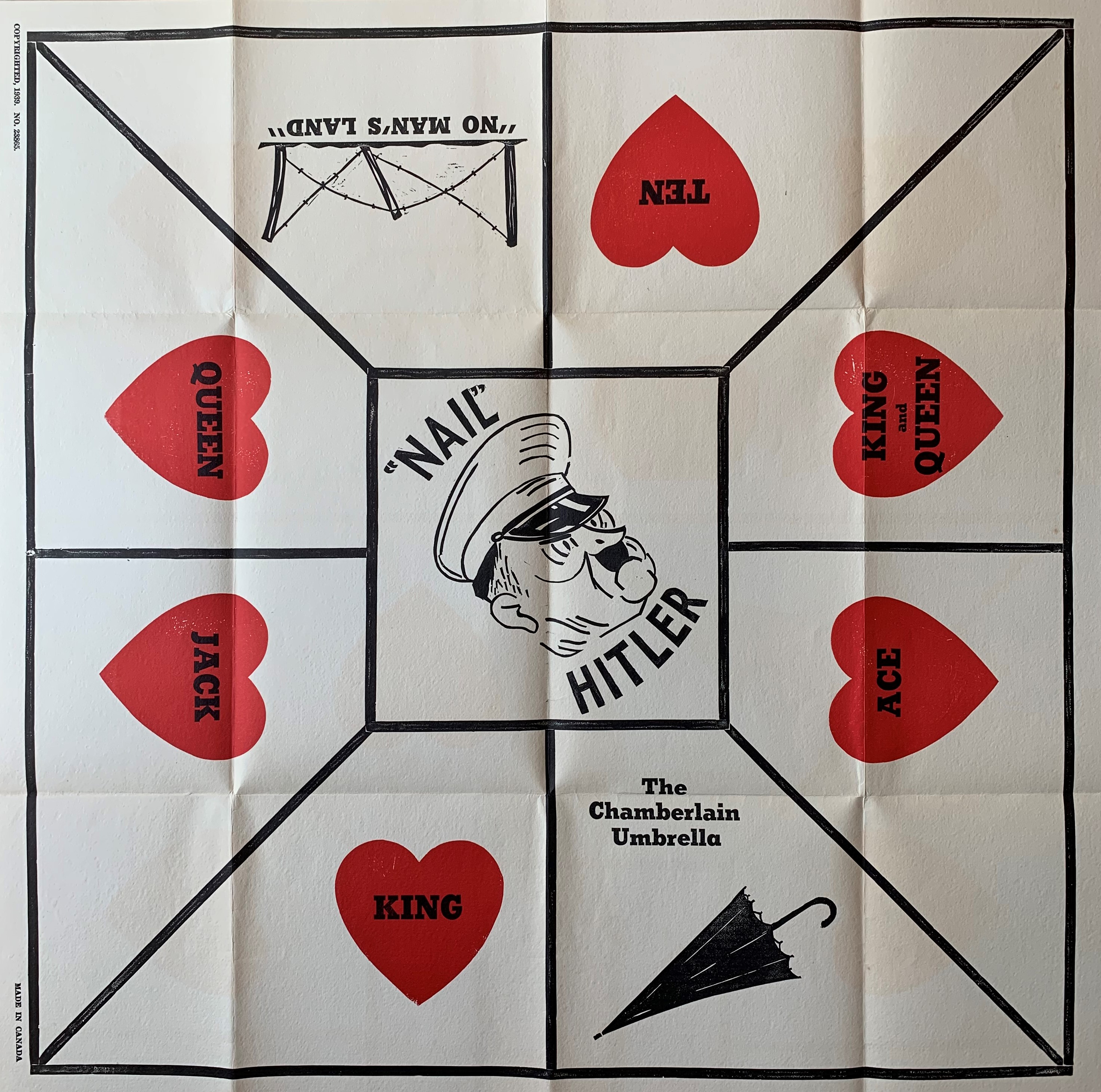
Nail Hitler is a themed version of Army Rummy. Each player puts a coin in the Hitler pot and enough coins to ensure that each surrounding space has at least one. A regular deck of cards is dealt out among the players with an extra “dummy” hand. The dealer can take the dummy hand instead of his own. If he does not, he must auction the dummy to the highest bidder.
The starting player lays down the lowest card he has of a suit. Whoever has the next higher card up in the suit follows, until no one has a higher card in that suit. Aces are high. The player of the last card starts a new suit, which must be opposite in color. This repeats until one player manages to get rid of all his cards. That player calls “Nail Hitler” and takes the central pot. The other players must pay him an amount equal to the number of cards still in their hands and must put an equal amount into the No Man’s Land space.
Players collect the other pots as they play the needed cards. The King-Queen space requires the same player to hold both cards. Anyone able to play three cards in sequence collects whatever is in The Chamberlain Umbrella space. A sequence of four cards wins No Man’s Land. Any pots not claimed during a hand stay on the board, and all players ante again before the cards are re-dealt.
The Chamberlain Umbrella comes from the actions of former British Prime Minister Neville Chamberlain. He carried his umbrella constantly while negotiating “peace for our time” with Adolf Hitler in Munich in 1938. It became an enduring symbol of well-intentioned but futile appeasement.
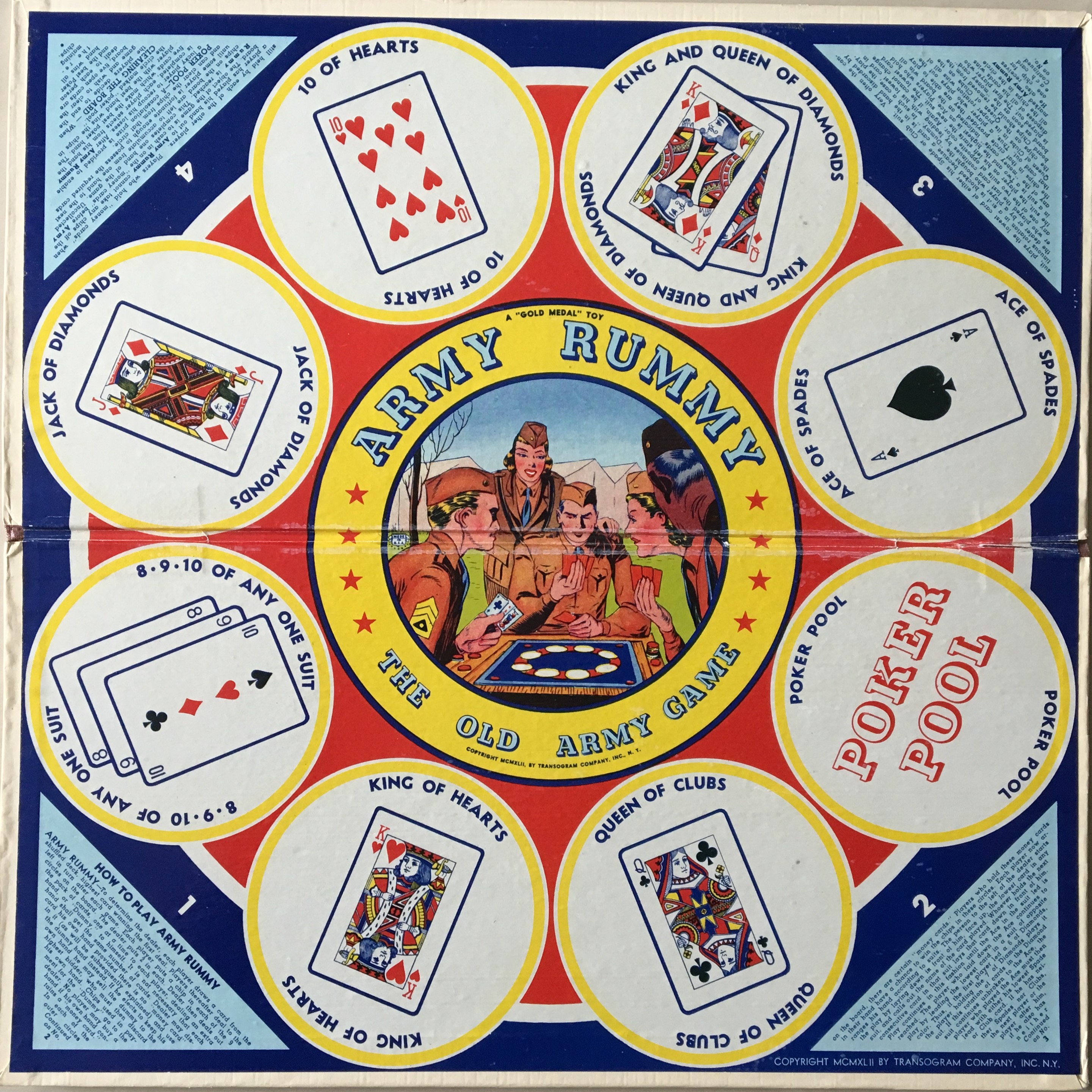
This example of Army Rummy game was published in 1942.
The bonus spaces are for different cards spread across all the suits: The Ace of Spades; King and Queen of Diamonds; King of Hearts; Queen of Clubs; Jack of Diamonds; and 10 of Hearts. There is a similar space for any sequence of three cards, and a Poker Pool space.
As in Nail Hitler, the player with no cards left collects a chip for each remaining card from each other player, but there is no equivalent of No Man’s Land.
Instead, players pick up all the cards they played, and the one with the best poker hand collects that pool.
“Hate the enemy” type games can have a more serious tone. Take for example the early WWII German game Radio-Sende-Spiel (Radio Broadcast Game). Once again, players simply roll dice and move along a 100-space track that circles Germany and extends into surrounding countries. The game focused on reminding Germans that it was illegal for them to listen to foreign broadcasts.
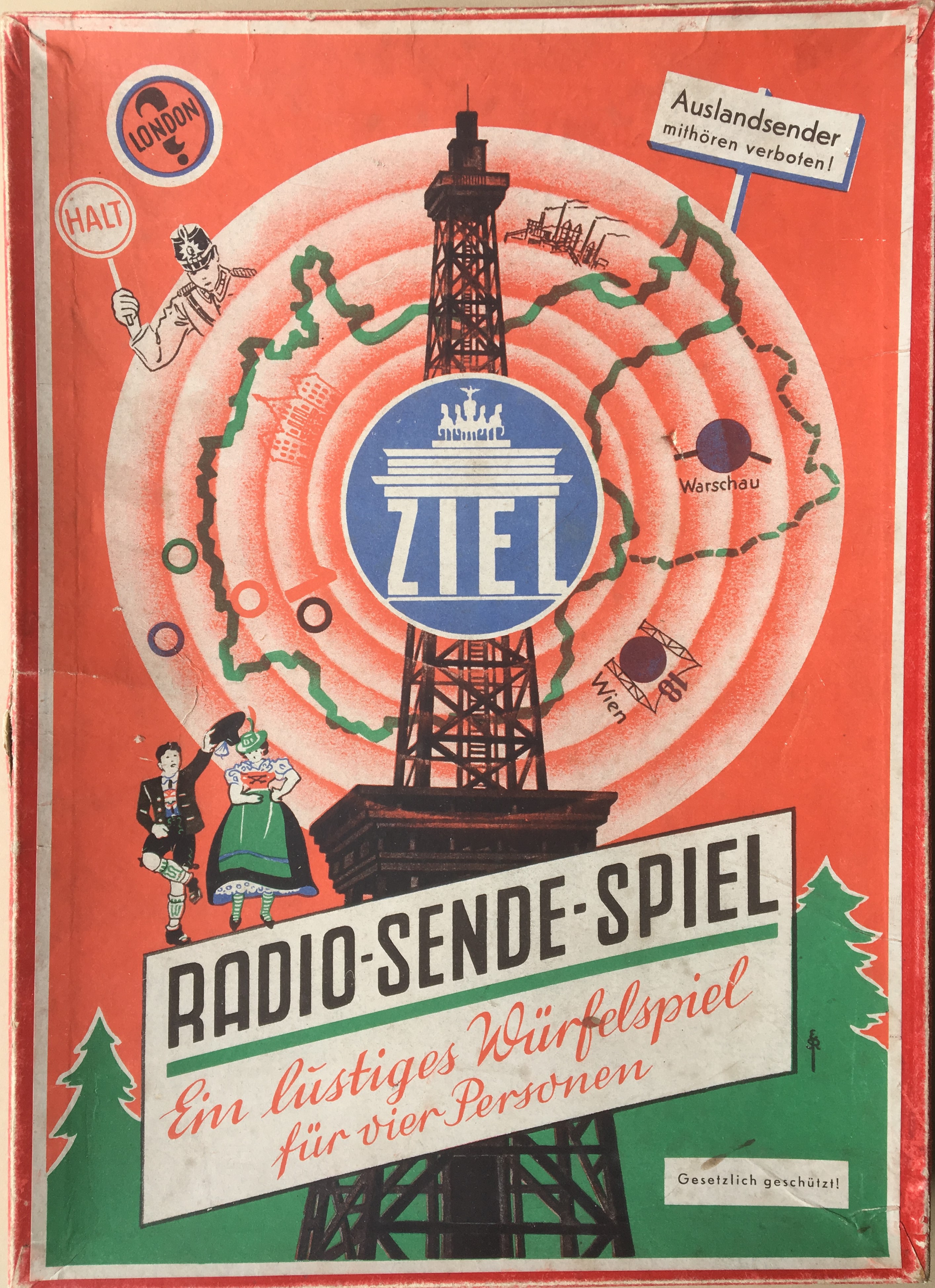
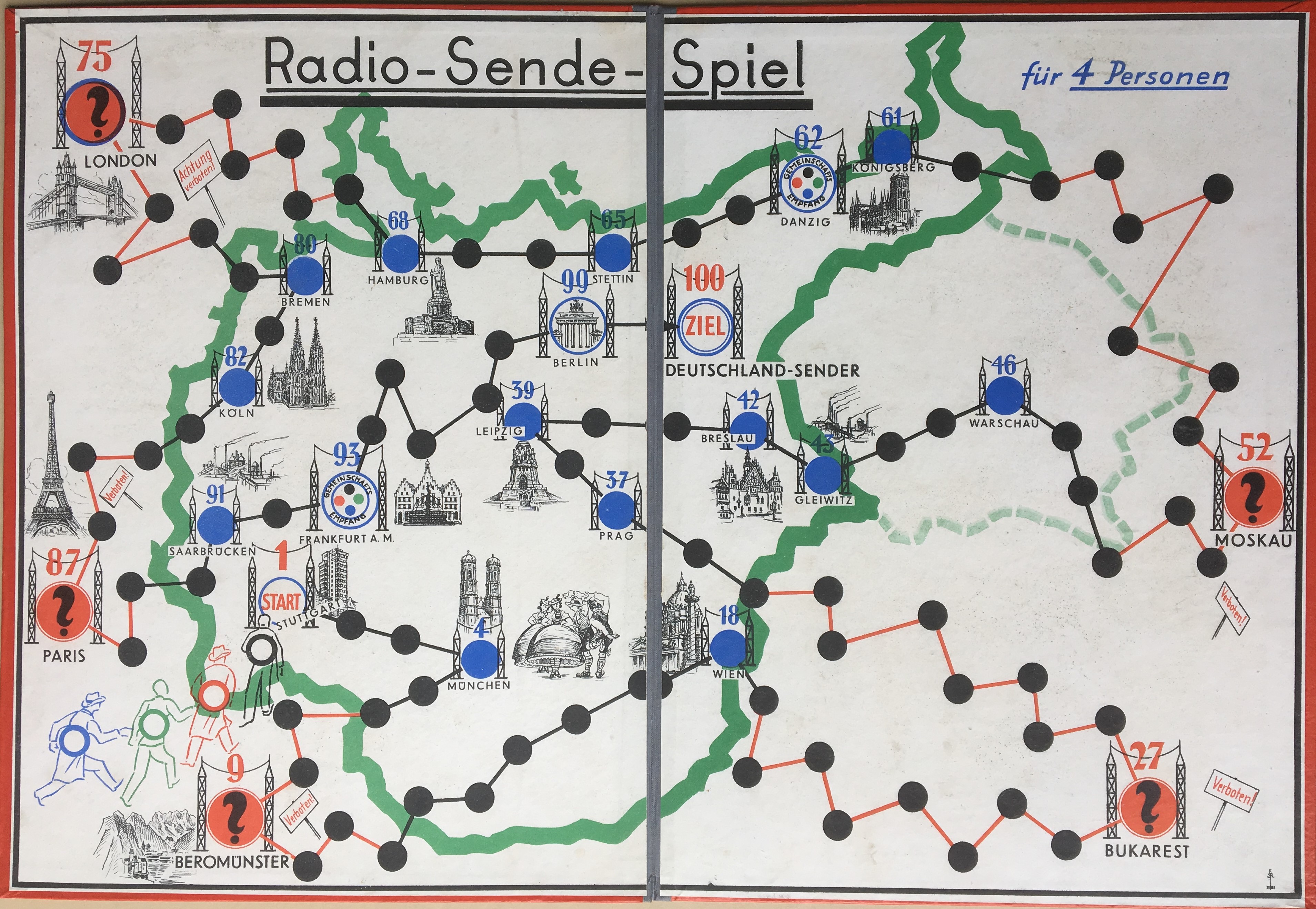
Any player unfortunate enough to land on a transmitter in Paris, Moskau, Bukarest or Beromunster (a city in Switzerland) must pay a pfennig into the pot. In addition, that player must stand up and announce in a loud voice: “I have committed a crime!” The player’s token is then sent back to the start.
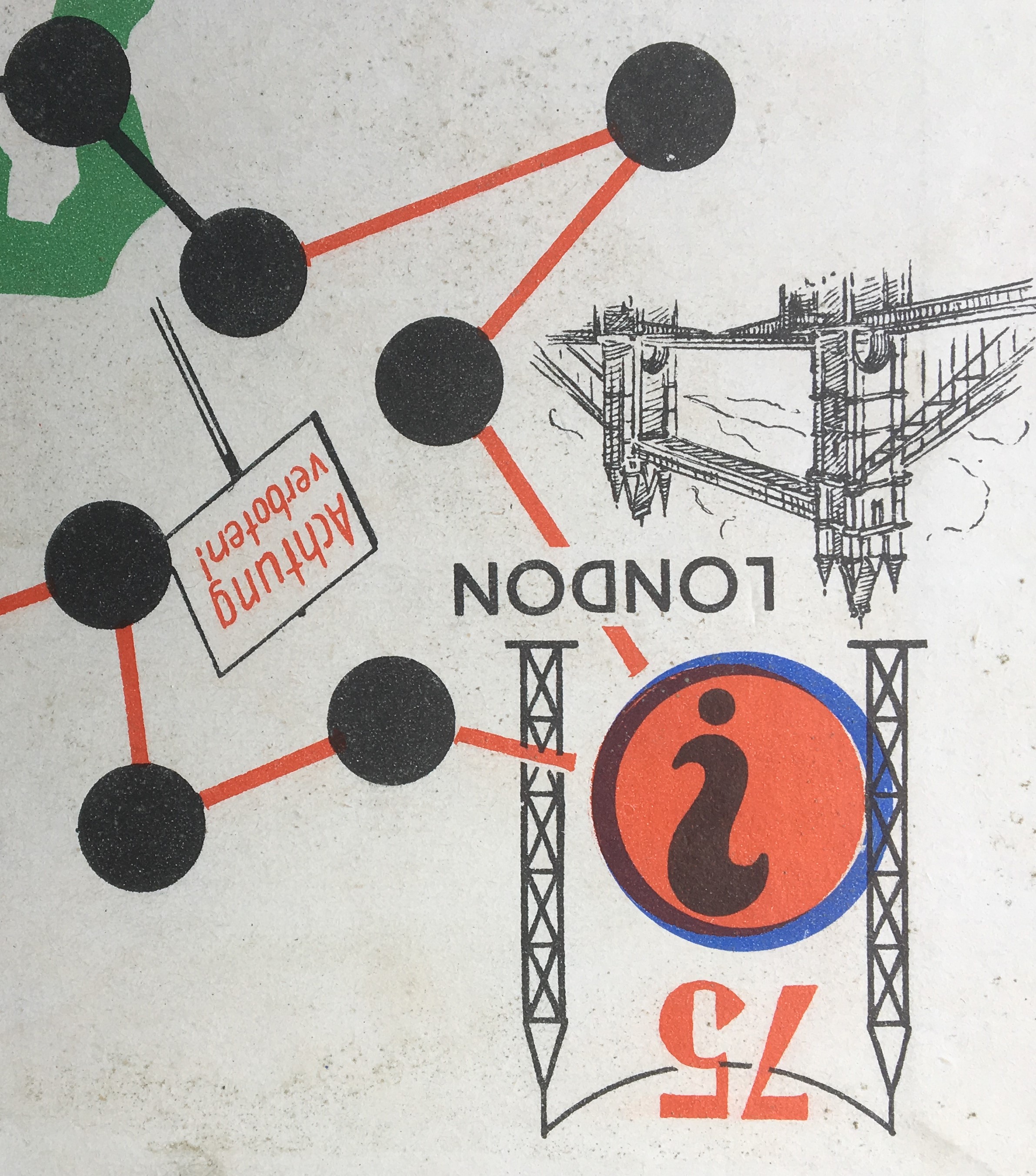
And woe betide any player landing on the transmitter in London, described in the rules as the “main enemy”. That player must pay five pfennigs to the pot, stand up and shout “God D*** England!” and is out of the game. The first player to reach the end of the track takes the pot.
Some wartime games expressed a more subtle patriotism. In 1909, the Orientalische Tabak- und Zigarettenfabrik Yenidze (Yenidze Oriental Tobacco and Cigarette Factory) completed a new factory and office building in Dresden.
The company was founded by Hugo Zietz, and imported its tobacco from the Ottoman Turkish province of Yenidze (now part of Greece). The building’s dramatic architecture advertised the exotic origins of its tobacco.
The Moorish design included a pointed dome and colored domed chimneys that looked like minarets. It became known informally as the “tobacco mosque”.
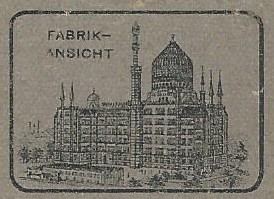
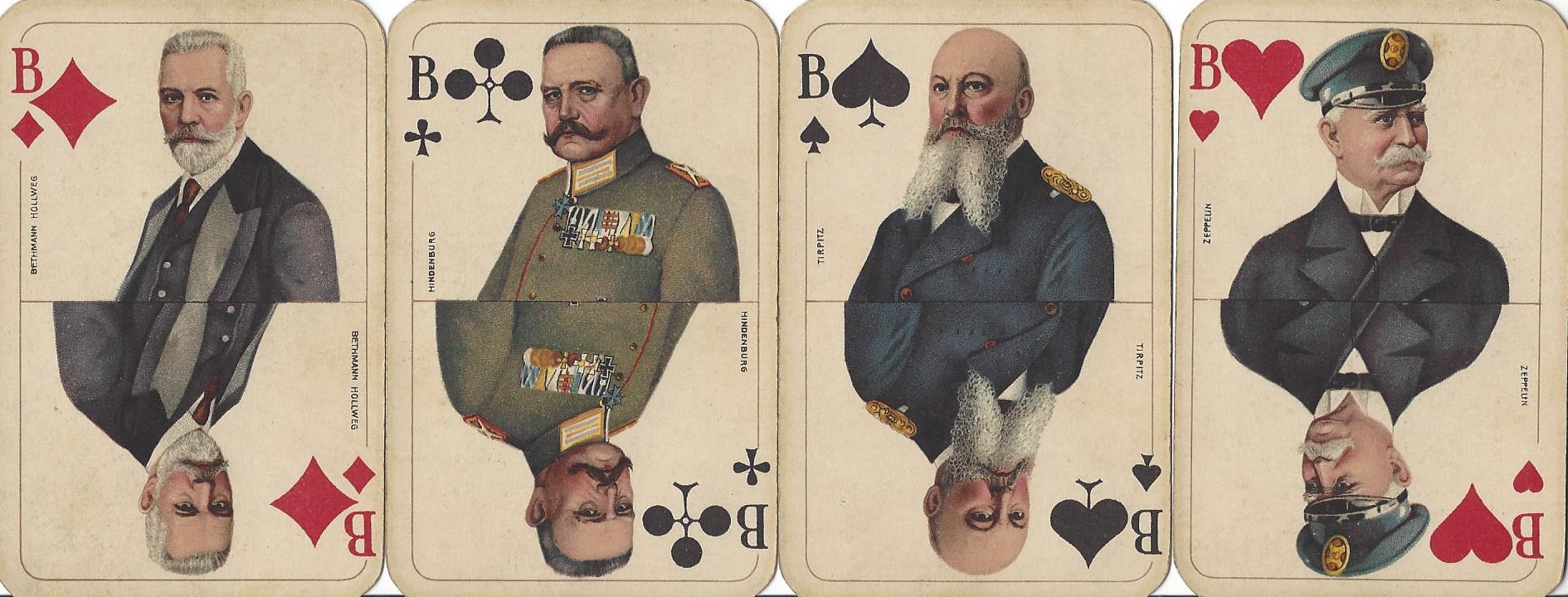
During WWI, the company published a different kind of advertising in the form of a 32-card deck for the game Skat. The box featured the picture of Yenidze’s factory (above) and both the box and the backs of the cards were advertisements for the company’s tobacco products (including the tagline “Always for you”). The aces featured the coats of arms and mottos of the four kingdoms within the German Empire: Prussia, Bavaria, Saxony and Wurttemberg, and the Ace of Hearts features what looks like a wartime tax stamp.
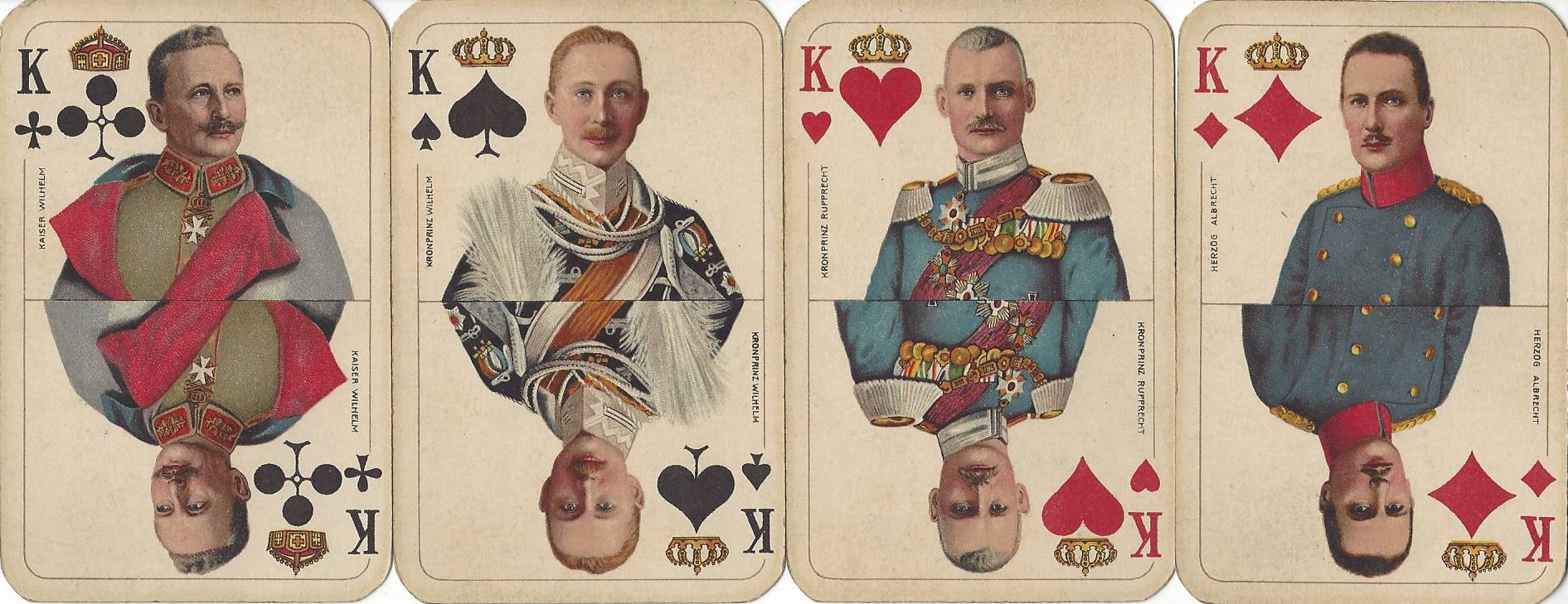
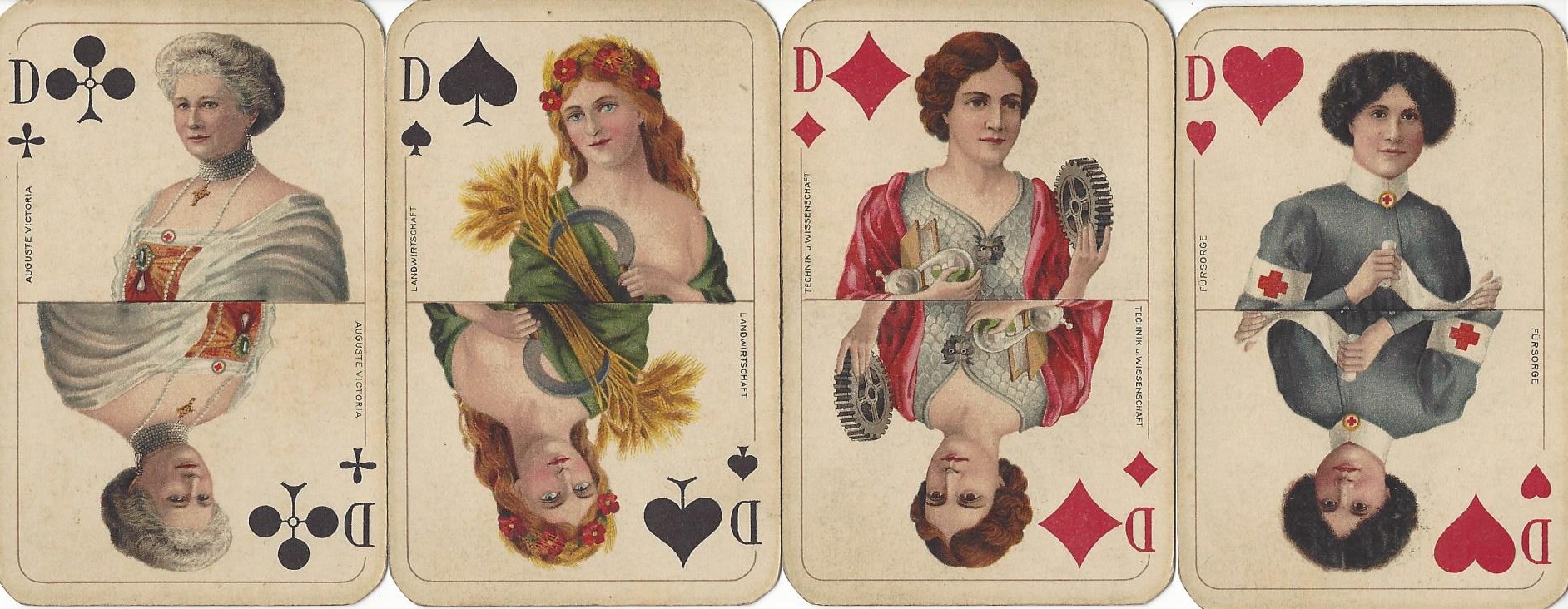
The face cards reflect a who’s who of the empire’s wartime leadership. The Kings are Kaiser Wilhelm II, Crown Prince Wilhelm of Prussia, Crown Prince Ruprecht of Bavaria and Grand Duke Albrecht of Wurttemberg. The Queen of Clubs is Kaiser Wilhelm’s wife Auguste Victoria. The other Queens are female portraits representing Agriculture, Science and Technology, and Care. The latter has a portrait of an anonymous nurse. This is the deck’s most direct reference to the war.
The Jacks show other key leaders: German Chancellor Theobald von Bethmann-Hollweg; General Paul von Hindenburg, the hero brought out of retirement to smash the Russians at the Battle of Tannenberg; Grand Admiral Alfred von Tirpitz, the Empire’s leader at sea; and airship pioneer Ferdinand, Graf von Zeppelin, later pressed into service with both Germany’s army and navy.
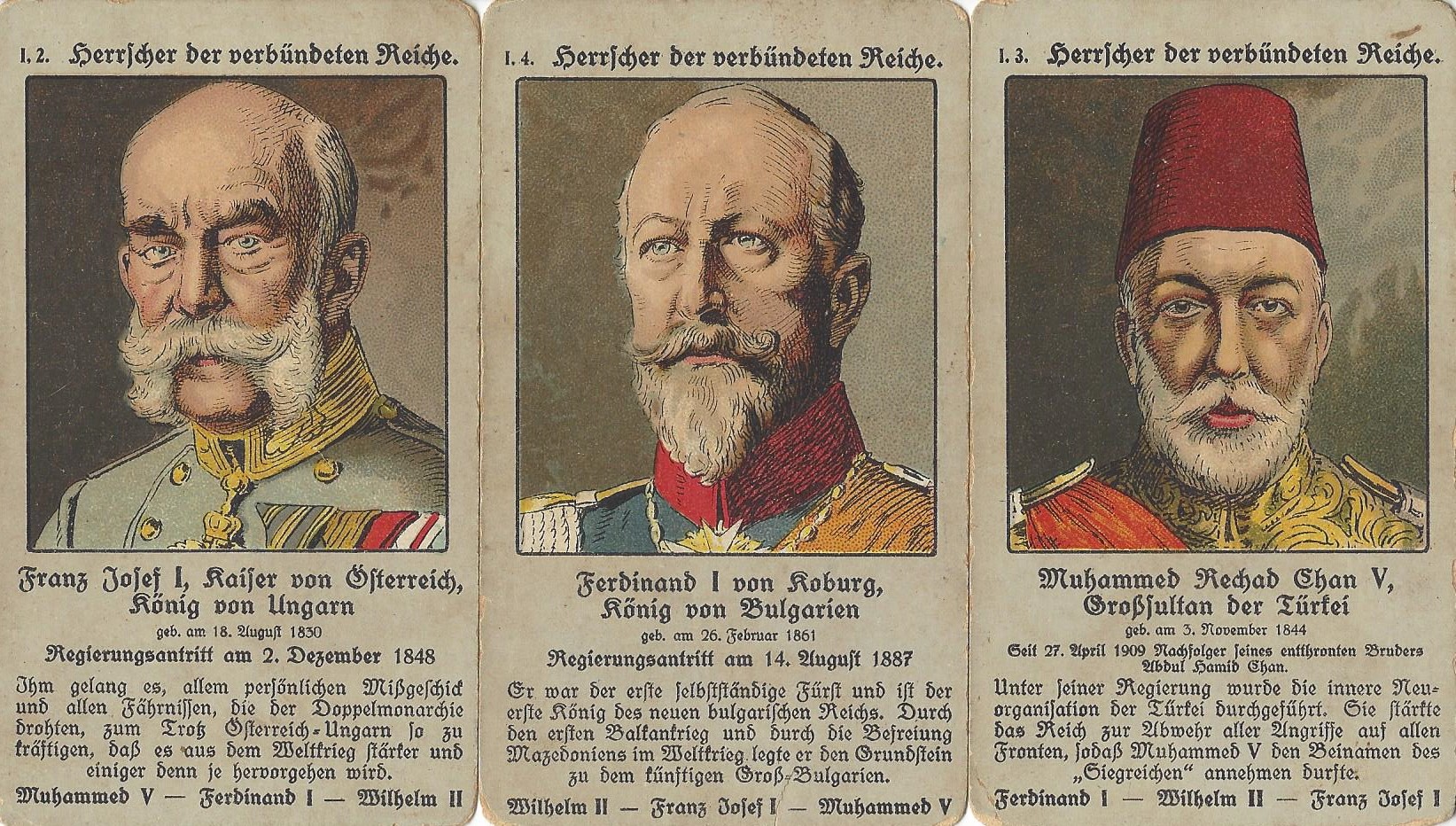
Card games like the one known in Germany as Quartett provided more graphic opportunities to celebrate leadership figures. This plays like Happy Families or Authors. The deck is divided in sets of four, and players try to collect sets by asking other players for the cards they need.
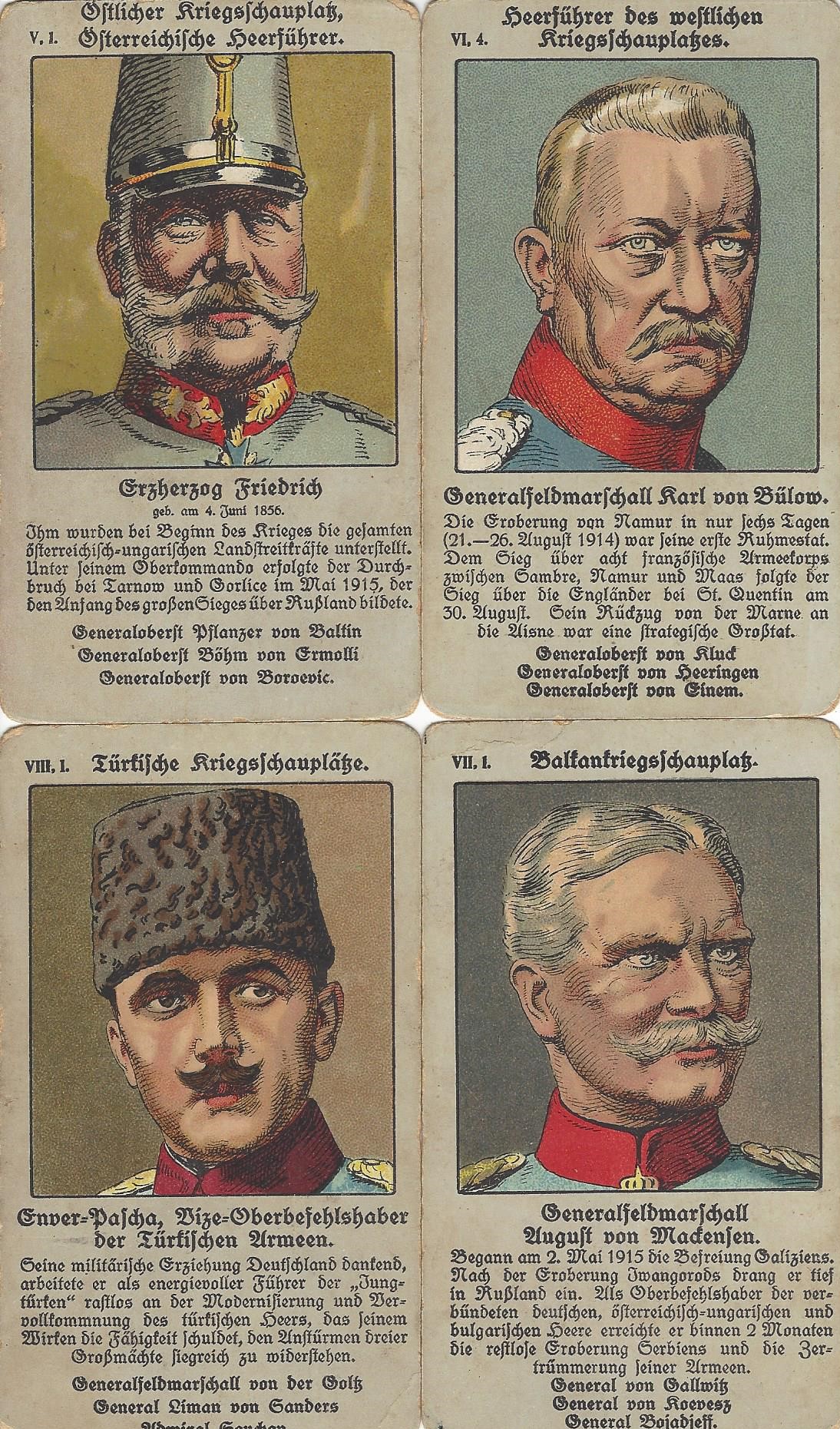
This Quartett deck published in mid-war included colored portraits of national and military leaders across the Central Powers. The national leaders (right) include Austrian Emperor Franz Josef I, Bulgarian King Ferdinand I and Sultan Muhammed Rechad V (Mehmed V) of the Ottoman Empire. The deck then goes through army heads and chiefs of staff, to the commanders of the four fronts:
- Erherzog (Grand Duke) Friedrich was Supreme Commander of the Austro-Hungarian Army, taking on the Russians.
- Karl von Bulow was promoted to Field Marshal in 1916 and put in charge of the Western Front despite his failure to capture Paris in 1914.
- August von Mackensen, nicknamed “The Last Hussar”, was perhaps the most successful German general of the war. He led the XVII Corps at Tannenberg. In early 1915, he led a combined German-Austrian army group to retake Galicia. In October, he led the German, Austrian and Bulgarian forces against the Serbs in the Balkans and then against Romania.
- Finally, there is a card for Enver Pasha, titled here as Vice-Commander of the Turkish Army. Enver was a leader in the 1908 Young Turk revolution by the Committee of Union and Progress, and of the 1913 coup after the CUP regime was toppled in 1012. He became one of the triumvirate of the “Three Pashas” and Minister of War, a position he would hold until fleeing the country in 1918.
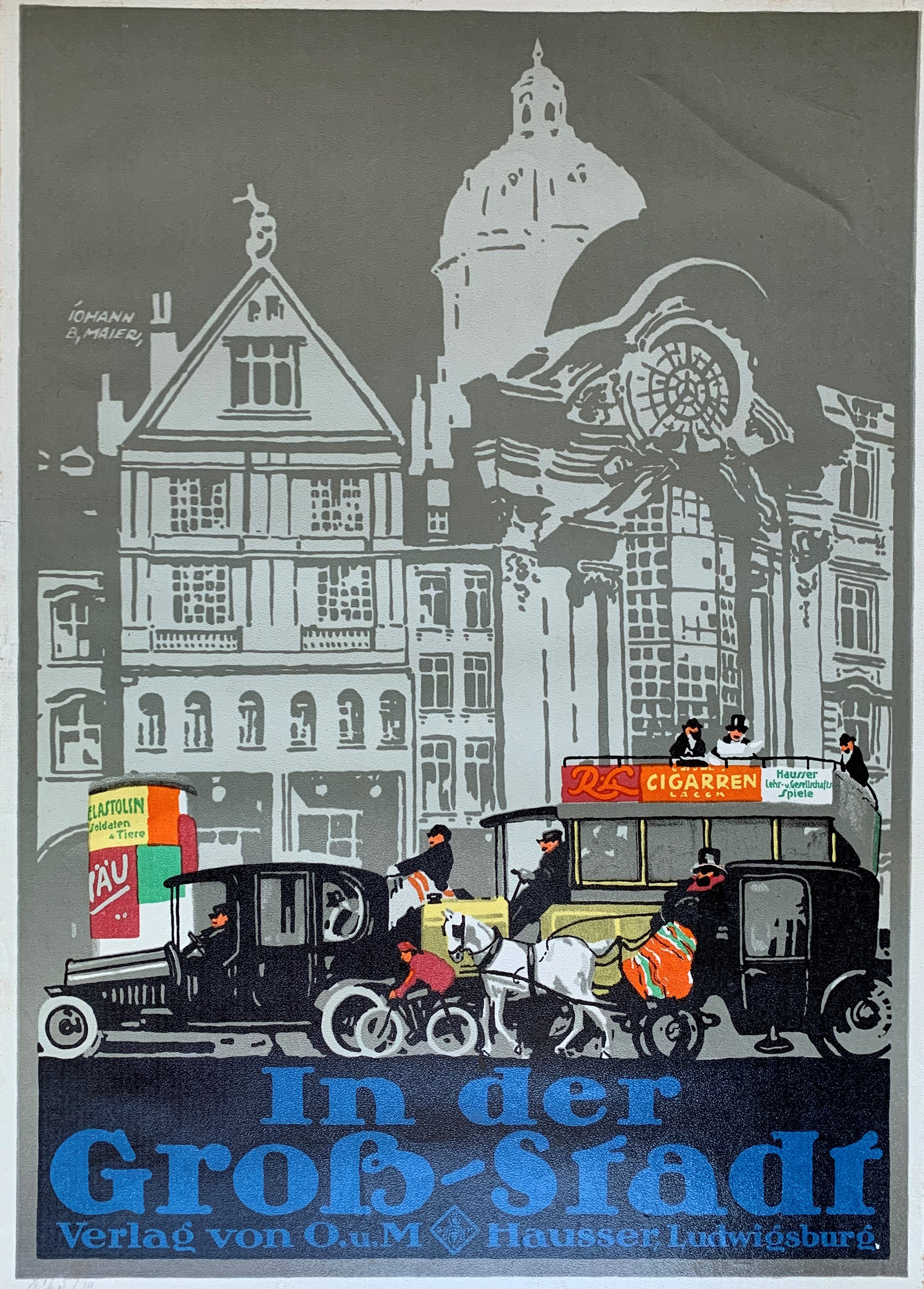
Some wartime games tried simply to send a message of calm. In 1915, O&M Hausser published this game about life in the German capital of Berlin: In der Gross-Stadt. This roll-and-move game gives players a thorough tour of all of the capital’s many cultural attractions.
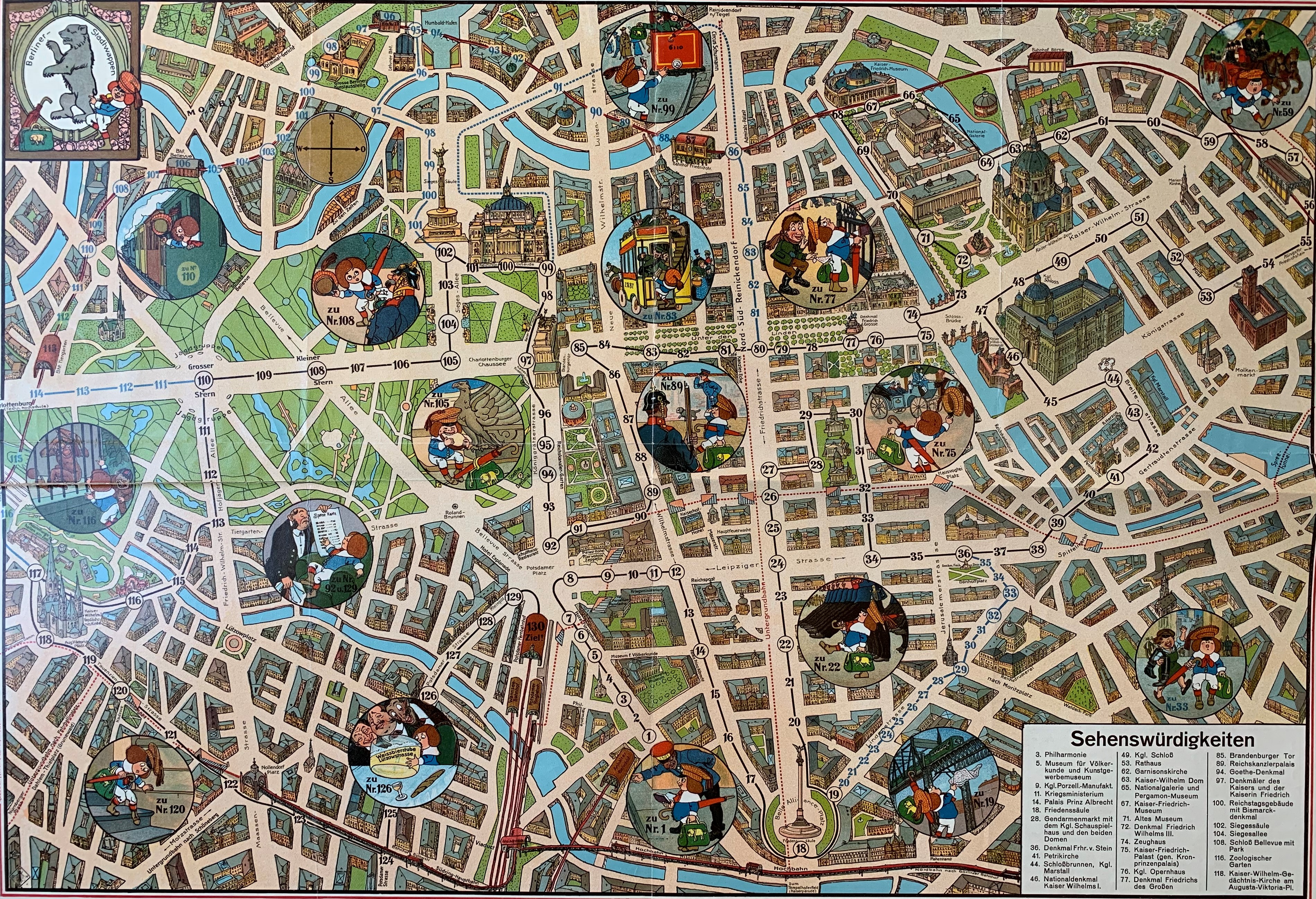
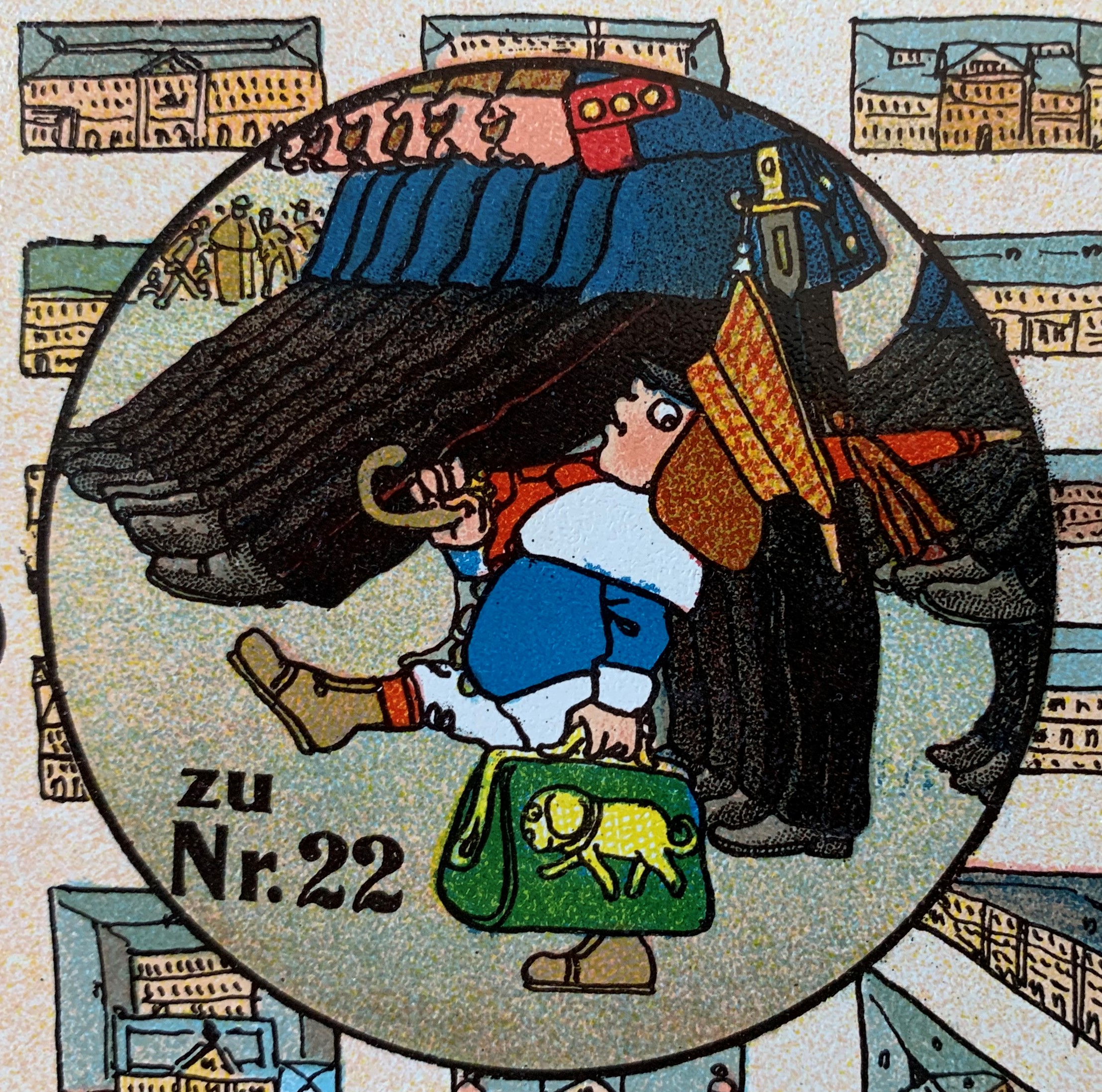
In the bottom right of the board is a large box with a list of what to do and see. These include the Philharmonic, the War Ministry, the Prince Albert Palace, the Kaiser Friedrich Museum, monuments to Kaiser Wilhelm I, Frederick the Great and Goethe, and the Brandenburg Gate. The only hints that a war is on can be seen in close-up images of the little boy as he tours the big city, such as this one showing him marching with his umbrella alongside a rank of soldiers on parade.
Games were also used to bring comfort to soldiers at the front. This Unterhaltungsspiel fur Soldaten was produced by the German army and distributed via military post to front-line soldiers during WWII.
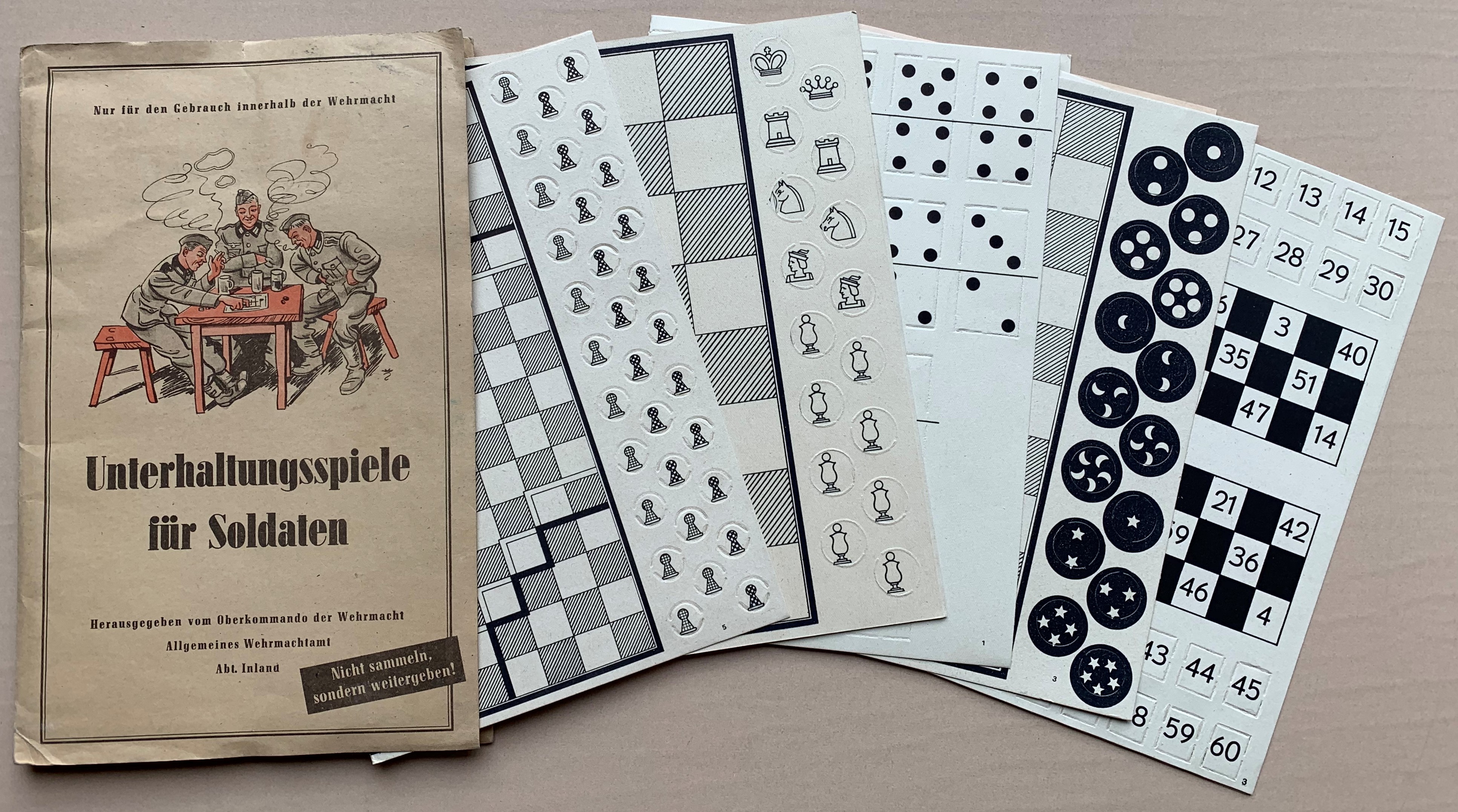
The envelope contains a host of cardboard game boards and pieces. There is a chessboard for chess and checkers, with a backside that allows Festungsspiel (Belagerungsspiel) and the very similar Wolf and Sheep. The same board can be used to play solitaire. There is another 10 by 10 checkerboard with the pieces for Salta.
Salta is a variant of checkers played with 15 pieces each, divided into stars, moons and suns, each numbered one to five. Pieces move diagonally and jump enemy pieces as in checkers but do not capture counters. The goal is to be the first to move all 15 pieces into the final three ranks opposite, in the same set of ranks and order.
In addition, there is a board for Halma, another checkers-type game where players move from corner to opposite corner. There is a set of dominoes. And there is a set of lotto (bingo) cards with matching number tokens.
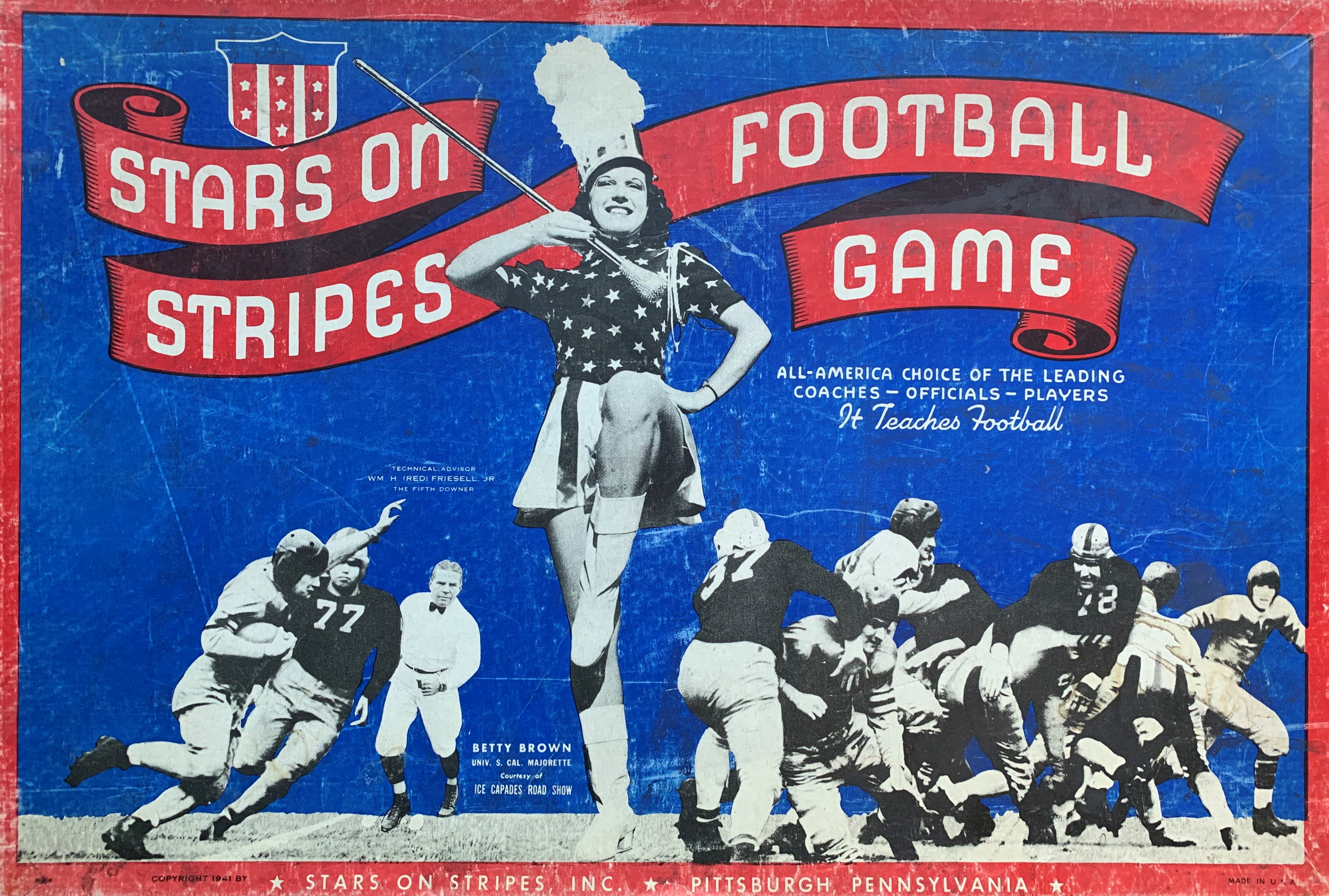
Other wartime games wrapped civilian activities in patriotic garb. Stars on Stripes Football Game was a conventional football board game, but its cover featured Betty Brown, described as a University of Southern California majorette. She is wearing a starred top and a striped skirt. The photo, a bit oddly for a football game, was said to be courtesy of the Ice Capades, a skating spectacle founded in 1940.
Celebrities were also recruited in wartime to wave their personal flags for the greater cause. Kate Smith was a singer who reached the peak of her career during the war years. She became known as The First Lady of Radio during the 1930s as a result of a series of popular programs for CBS.
In 1937, The Kate Smith Hour started an eight-year run as one of the top radio variety shows, mixing music with personalities and comedy, including Abbott and Costello. Some of her greatest hits came during the war years, including The White Cliffs of Dover in 1941 and The Last Time I Saw Paris in 1942. She is perhaps best remembered for her rendition of Irving Berlin’s God Bless America, which hit the charts for the first time in 1939 and remained a wartime favorite. She also was an enthusiastic booster of the American war effort and hosted a series of radio marathons.
These brought in war bond sales of $600 million (worth more than $10 billion today), which made her the most successful fundraiser of the war.
Another part of that fundraising effort came through America: Kate Smith’s Own Game, published by Toy Creations Ltd. in 1944. This is an unashamedly patriotic affair. Even the inside of the box is arranged to show an American flag, with a sheet of stars over the rules next to player tile racks set on their side to show bright red and white stripes.
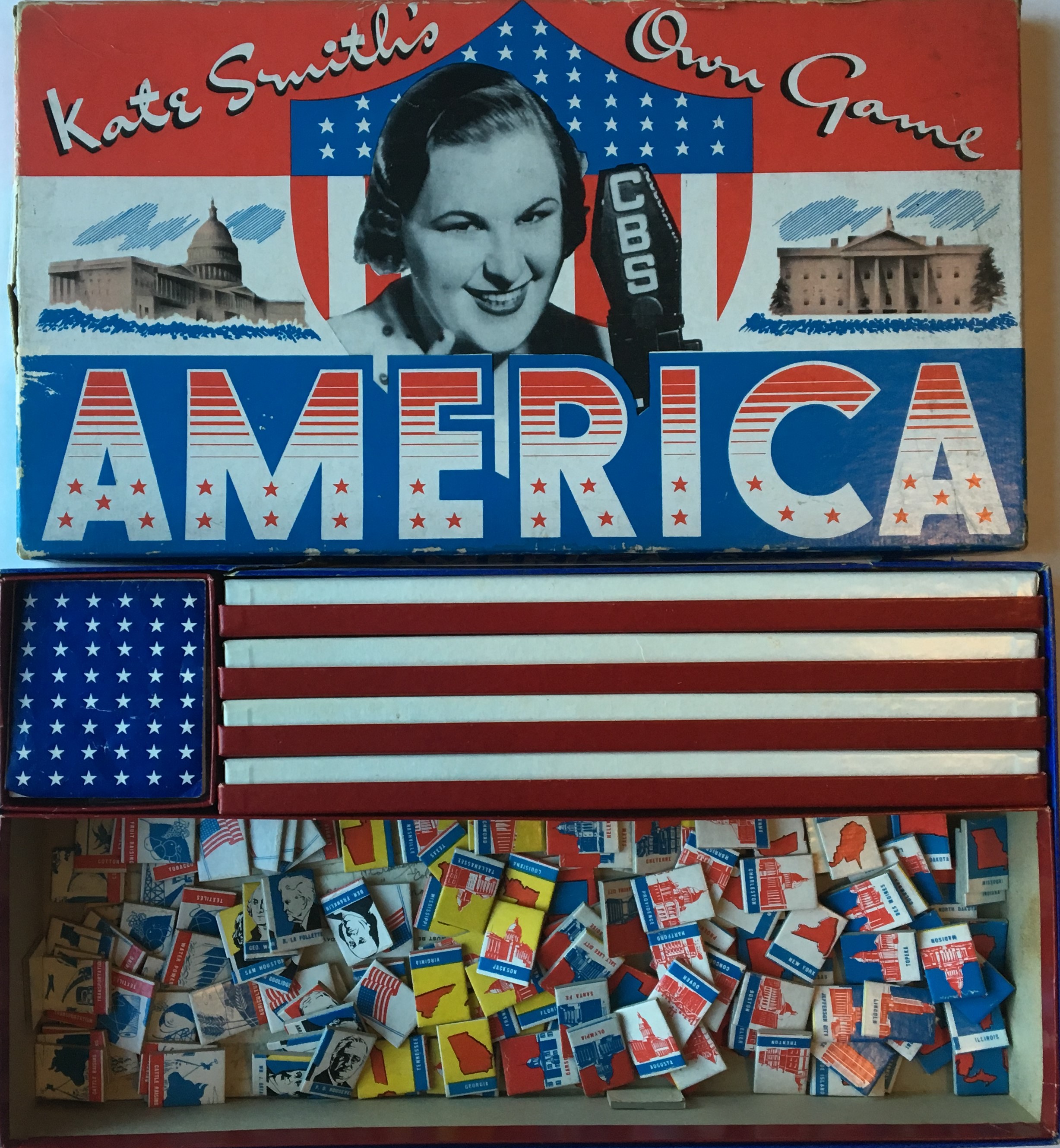
The game is a set-collecting tile game, similar to mah-jongg. There are 144 illustrated cardboard tiles: 48 states divided into four regions; 48 state capitols; 30 primary industries; 10 “favorite sons” and 8 American flags (wild cards).
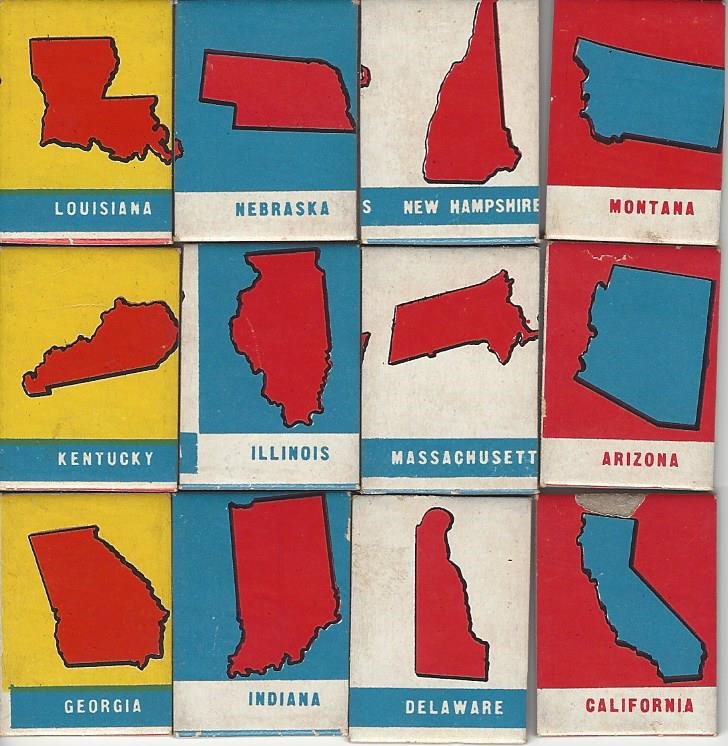
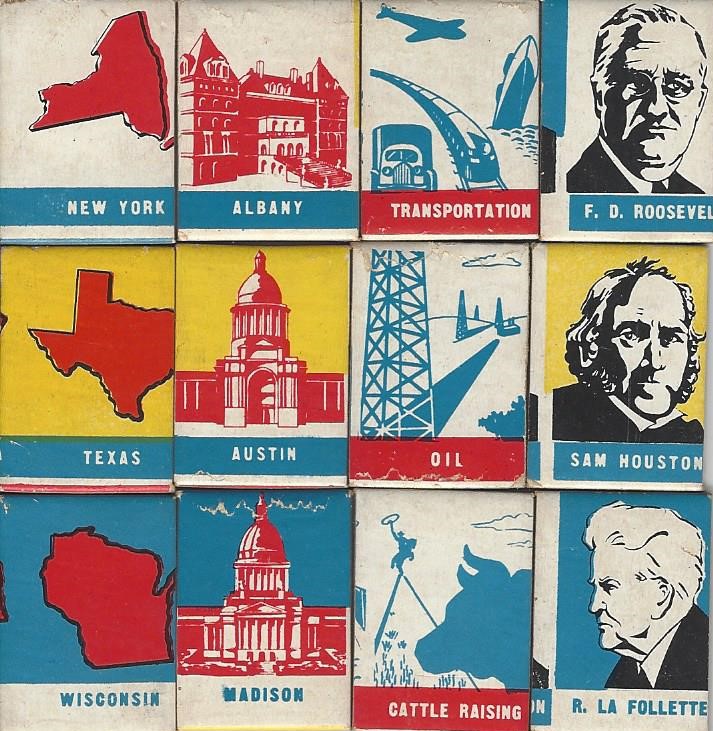
Each state is associated with three “principal products and industries”. The rules include reference pages showing each state’s three most important industries and favorite sons where they exist. A player who is not sure about whether an industry or favorite son matches a state may ask for the information, but pays a penalty of five tokens. Each player starts with a hand of 12 tiles. In turn, a player first draws a tile and then discards a tile. The next player may either take the discard or draw from the stack. As in mah-jongg, any player may claim a discard if it completes a set.
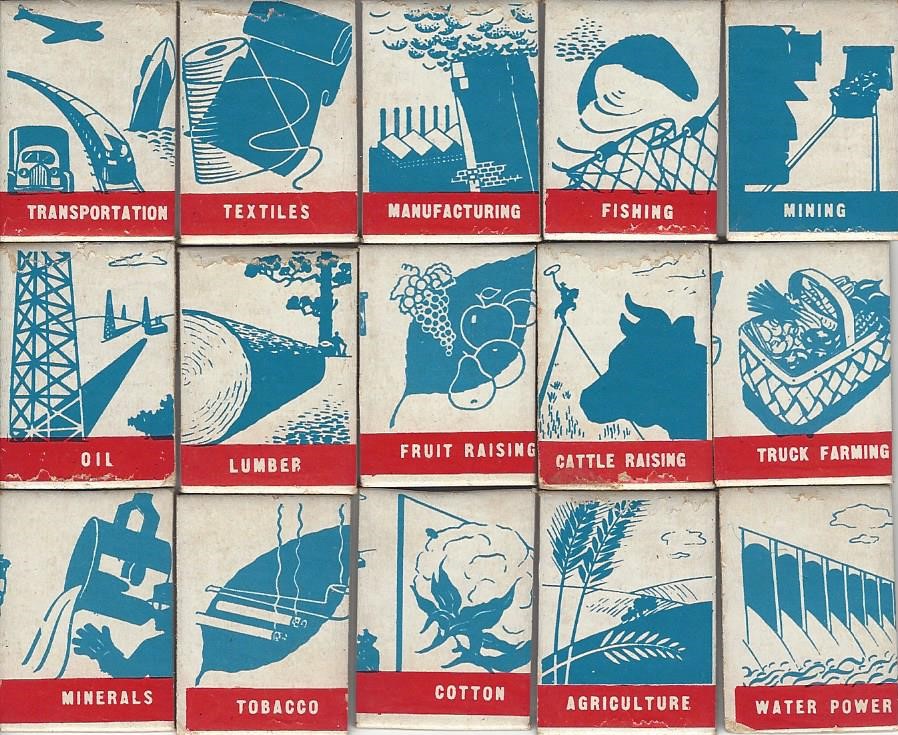
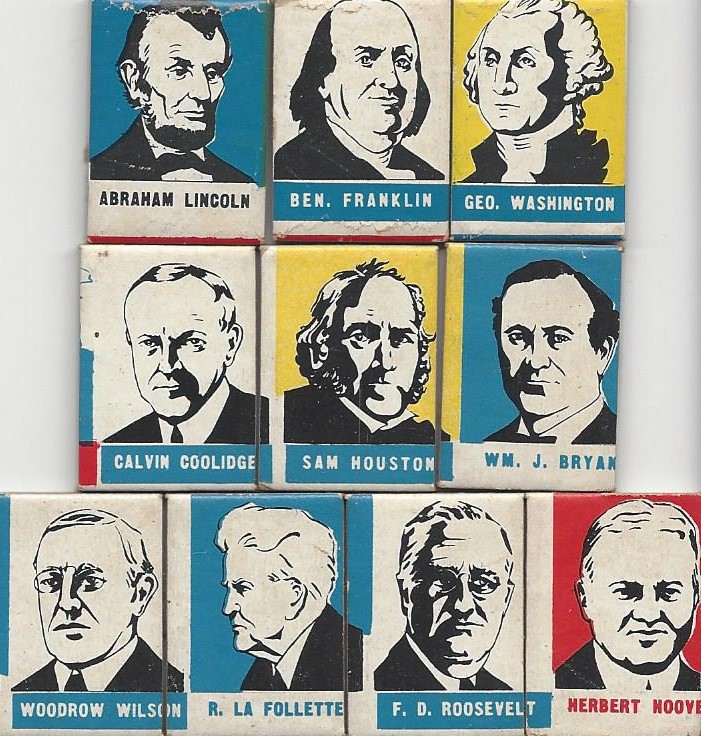
There are eight possible scoring combinations. The easiest, worth five points, is a hand comprised of three states in each of the four regions. The hardest is worth 30 points. It must contain three states, each with their capitol, one of its industries and a favorite son. Since only 10 states have favorite sons, wild cards tend to be critical in achieving such a hand.
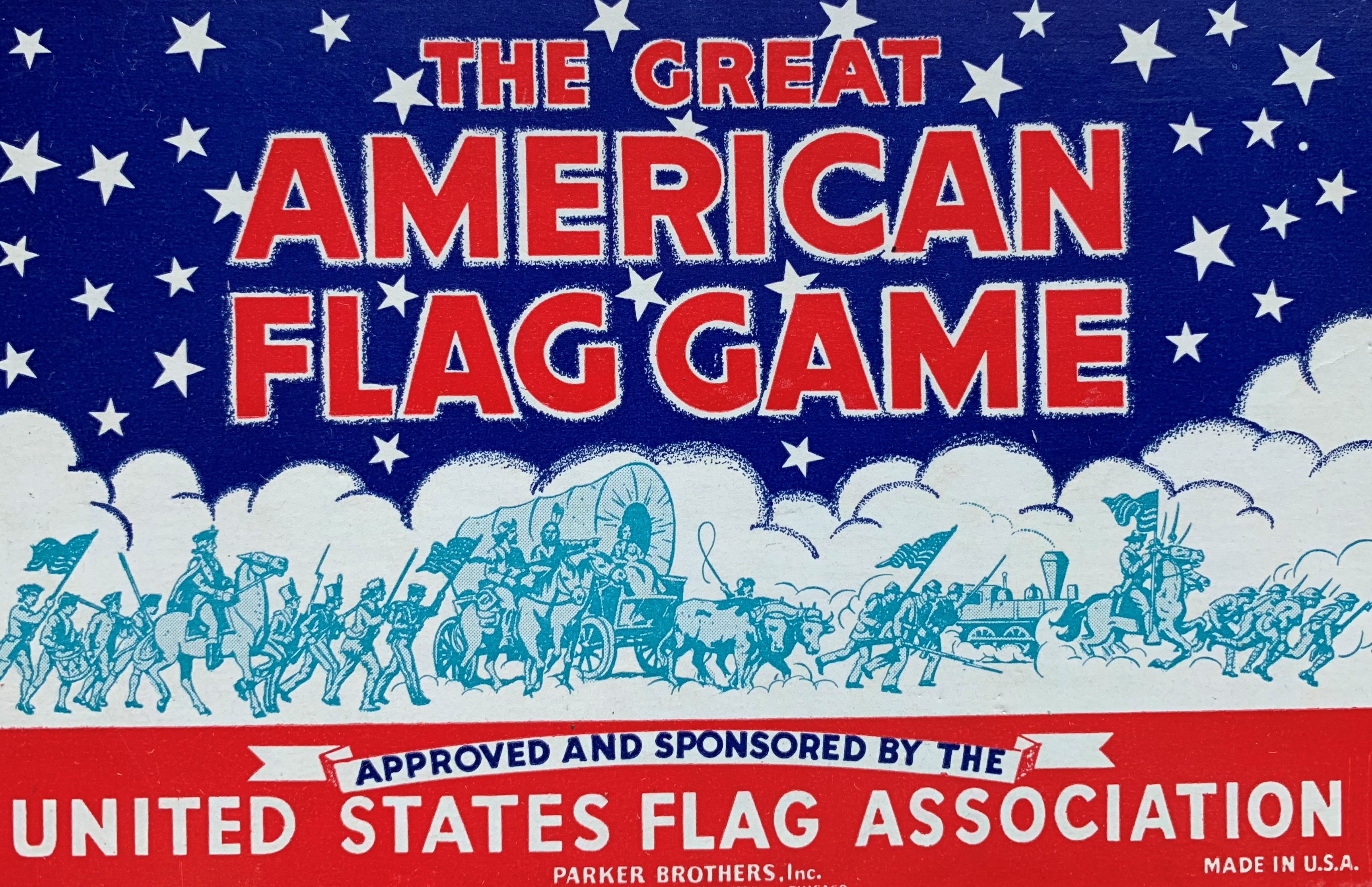
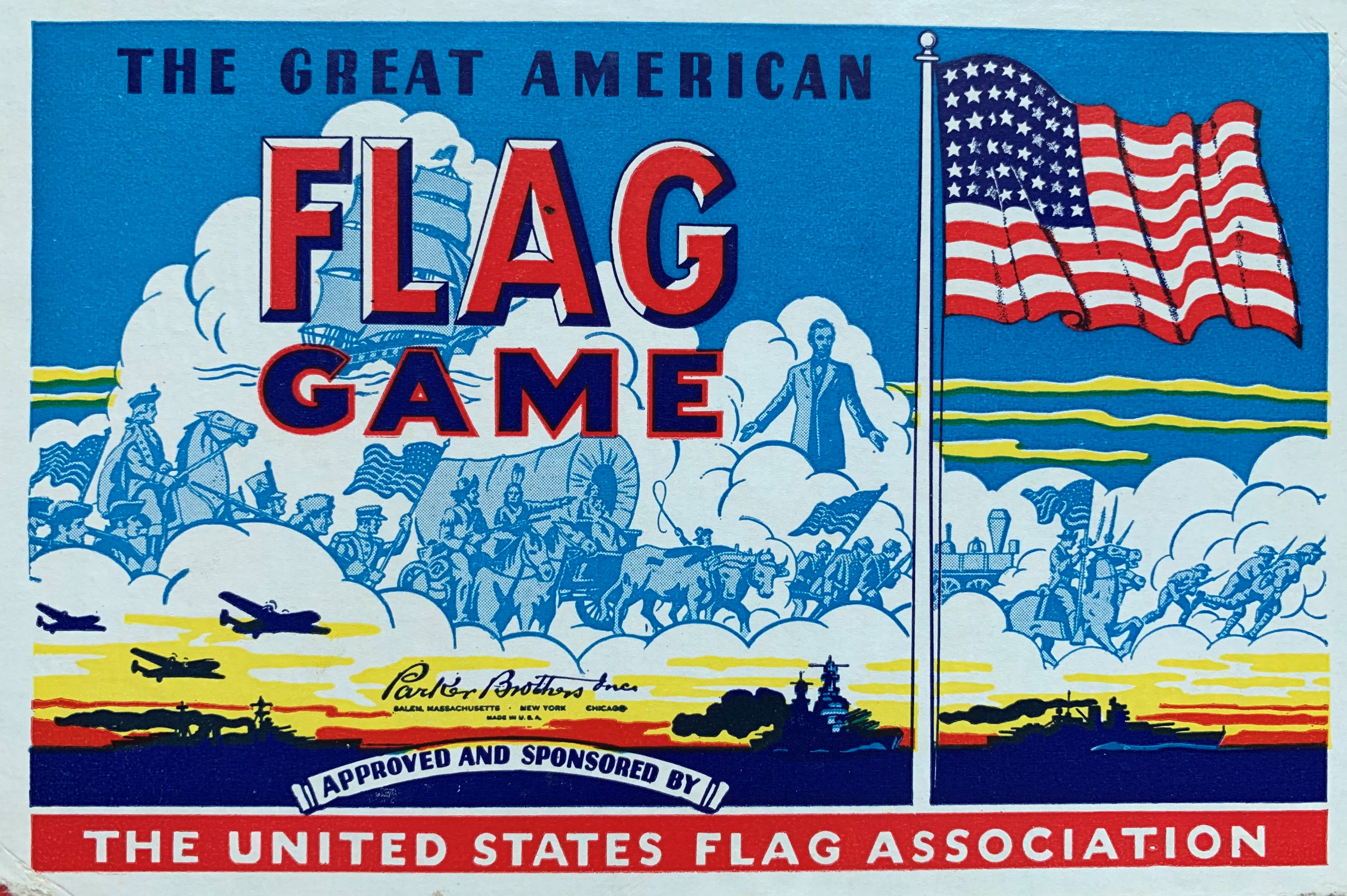
Nothing pumps up the patriotic heart in wartime more effectively than the national flag itself. The Great American Flag Game was first published by Parker Brothers in 1940, while the United States was still fairly isolationist. The game was described as “approved and sponsored by The United States Flag Association”. The box cover and board label feature images of America’s past, from the War of Independence through WWI.
Parker put out a second edition in 1943. The box and label on this edition retain the original images of American history. But an image of the 48-star flag itself is given prominence on the upper right. And images of the current war dominate across the bottom: bombers and warships silhouetted against a setting sun.
As with recruitment games, these patriotic offerings were not issued as government propaganda. They were produced commercially, both by established game publishers and entrepreneurial start-ups looking seize sales from the times. Supporting the home team in war was simply good business.
War is deadly to civilians and to military personnel alike. But even in the darkest hours, people need comfort. The themes of wartime games are clearly intended to support morale – both through the messages on their boards and in their rules, and through the eternal pleasure of social interaction that games provide.